

FLSUN T1 Pro 3D printer represents a significant leap forward in desktop delta printing technology. With claimed speeds up to 1000mm/s, a fully enclosed cylindrical build volume, and intelligent features like AI camera monitoring and auto-leveling, this machine targets users who need both speed and reliability without compromising on print quality.
After extensive hands-on testing with the FLSUN T1 Pro, we’ve pushed this printer through challenging prints, speed tests, and real-world production scenarios to see if it lives up to the hype. Delta printers have always promised speed advantages over traditional Cartesian designs, but they’ve historically struggled with calibration complexity and print quality consistency.
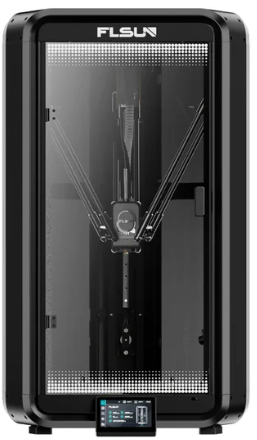
Does the FLSUN T1 Pro finally deliver on the delta printer promise? Let’s find out.
🚀 Quick Verdict: Is the FLSUN T1 Pro Right for You?
Best for: Advanced hobbyists, makers, and small businesses needing high-speed production with excellent vertical build capacity.
Not ideal for: Complete beginners with no 3D printing experience, those needing ultra-wide prints, users wanting plug-and-play simplicity.
Standout feature: 1000mm/s maximum speed with 260mm diameter × 330mm height enclosed cylindrical build volume and impressive print quality retention at high speeds.
Bottom line: The FLSUN T1 Pro delivers exceptional speed and vertical build capacity in a refined delta package, making it ideal for users who understand 3D printing fundamentals and need production-level throughput.
📖 Table of Contents (Jump to Section)
📍 Introduction: FLSUN’s Delta Evolution
FLSUN has been refining delta printer technology for years, and the T1 Pro represents their most ambitious effort yet. This isn’t just an incremental upgrade—it’s a complete reimagining of what a consumer delta printer can achieve.
The FLSUN T1 Pro enters a competitive space where speed-focused printers from Bambu Lab, Creality, and Anycubic dominate headlines. However, delta kinematics offer unique advantages: lighter moving mass enables faster acceleration, the cylindrical build volume maximizes vertical space, and the elegant mechanical simplicity reduces potential failure points.
At a price point of approximately $459–$499, the FLSUN T1 Pro positions itself as an attractive mid-range option that delivers premium features. It competes directly with CoreXY speed demons while offering distinct advantages for tall prints and users who appreciate the engineering elegance of parallel arm kinematics.
This FLSUN 3D printer targets intermediate to advanced users who’ve outgrown entry-level machines and need reliable high-speed printing without enterprise-level investment. Whether you’re producing prototypes, manufacturing small batch products, or creating tall artistic prints, the T1 Pro’s specifications suggest it can handle the workload.
📊 Printer Specifications (At a Glance)
Below is a comprehensive technical overview of the FLSUN T1 Pro 3D printer. Understanding these specifications helps evaluate whether this machine matches your printing requirements and workspace constraints.
✅ Who Should Buy This Printer
- Users who’ve outgrown entry-level printers and need serious speed improvements
- Makers printing tall models like vases, figurines, or vertical prototypes
- Small businesses requiring fast turnaround for prototype iterations
- Hobbyists who appreciate delta kinematics and want cutting-edge technology
- Users comfortable with intermediate 3D printing concepts and troubleshooting
- Anyone needing high-speed printing without sacrificing dimensional accuracy
❌ Who Should Not Buy This Printer
- Complete beginners with zero 3D printing experience (start simpler)
- Users needing very wide prints exceeding 260mm diameter
- Those wanting absolute plug-and-play with zero learning curve
- Anyone uncomfortable with firmware configuration or calibration fine-tuning
🎯 Best Use Cases
The FLSUN T1 Pro build volume of Ø260 × 330mm creates unique opportunities. The cylindrical, fully enclosed workspace maximizes vertical capacity while maintaining a compact desktop footprint—ideal for specific project types that benefit from height over width.
🏺 Tall Decorative Prints
Vases, lamp shades, and sculptural pieces that need vertical expression print beautifully on the FLSUN T1 Pro. The delta arm configuration maintains accuracy throughout the Z-axis without the wobble issues that plague some Cartesian printers on tall prints. You can print 300mm+ tall vases in single pieces without joints or assembly.
⚙️ Rapid Prototyping
Engineers and product designers benefit enormously from the FLSUN T1 max speed capabilities. When iterating through design revisions, cutting a 4-hour print down to 90 minutes accelerates development cycles dramatically. The high acceleration allows quick directional changes without compromising dimensional accuracy on functional parts.
🎭 Cosplay and Props
Helmets, weapon props, and armor sections that fit within the cylindrical build volume print quickly and cleanly. The speed advantage means you can produce multiple components in a single day, and the tall build height accommodates vertically-oriented helmet sections without splitting models.
📈 Small Batch Production
For makers running Etsy shops or small product lines, the FLSUN T1 Pro’s speed translates directly to increased throughput. You can print 3–4 items in the time competitors print one, enabling same-day or next-day order fulfillment that builds customer satisfaction and repeat business.
🔬 Educational and Research Applications
Universities and research labs appreciate the combination of speed and precision. When students or researchers need quick physical models for testing concepts, the FLSUN T1 Pro delivers results fast enough to maintain project momentum.
📦 Unboxing and Setup Experience
The FLSUN T1 Pro arrives in sturdy packaging with thick foam inserts protecting the printer’s arms and base. FLSUN clearly learned from previous generations—the packaging engineering here prevents shipping damage effectively.
📦 What’s in the Box
- FLSUN T1 Pro printer (semi-assembled)
- Acrylic side panels and glass door (enclosure components)
- Textured PEI magnetic build plate
- Power cable and adapter
- USB cable
- Tool kit (hex keys, wrenches, scraper)
- Spare nozzle
- Sample PLA filament
- PTFE tube and couplers
- Quick start guide and documentation
🔧 Assembly Process
Setup takes approximately 1 hour for someone with basic 3D printing experience. You receive the base, top lid, three vertical pillars with delta arms, enclosure panels, and the extruder as separate components. The main assembly tasks are:
- Attaching the three vertical pillars to the base and top lid
- Installing the acrylic side panels and glass door
- Mounting and connecting the extruder to the delta arms (slightly fiddly)
- Connecting the touchscreen and power supply
- Loading filament and running automatic leveling calibration
The touchscreen interface guides you through initial setup with clear visual prompts. The auto-leveling sequence takes about 5 minutes and creates a detailed mesh map of your build surface, ensuring excellent first-layer adhesion across the entire circular build plate.
✨ First Impressions
The build quality immediately impresses. The FLSUN T1 Pro feels substantial and well-engineered. The parallel arms move smoothly with minimal play, and the fully enclosed acrylic and glass housing gives the machine a professional, finished appearance.
The 4.3-inch touchscreen is responsive and intuitive. Navigation feels natural, and the interface provides clear feedback during printing operations. The included AI camera module sits prominently at the top, ready to monitor prints for failures.
⚙️ Build Quality and Design
🔩 Frame and Construction
The FLSUN T1 Pro uses a robust all-metal frame with precision-cut extrusions. The triangular base and top frame create a rigid structure that resists twisting forces during high-speed movements. This structural integrity is essential for delta printers, where frame flex directly impacts print quality. The fully enclosed acrylic and glass panels serve double duty: they contain the print environment for better material compatibility and reduce ambient noise.
The three vertical linear rails are mounted to the frame with precision-machined brackets. During testing, we observed no visible play or wobble in the arms even during aggressive acceleration moves.
🦾 Delta Arm Kinematics
The parallel arm configuration uses injection-molded carbon fiber reinforced joints connected to linear carriages via magnetic ball joints. This design minimizes friction while maintaining precise positioning across the build volume.
Each arm assembly includes:
- High-precision linear rails with sealed bearings
- Carbon fiber reinforced arm segments for rigidity with minimal weight
- Magnetic ball joints that allow smooth multi-directional movement
- Integrated belt tensioners for consistent drive performance
🔥 Hotend and Extruder
The all-metal hotend features a ceramic heater that reaches 300°C maximum temperature, enabling printing with engineering materials like polycarbonate and nylon. A dual-gear direct drive extruder provides consistent filament feeding with excellent grip on the filament.
The extruder design prioritizes reliability with:
- Hardened steel gears for durability
- Adjustable tension mechanism
- Integrated filament sensor for runout detection
🖨️ Build Plate
The magnetic textured PEI build plate provides excellent adhesion for a wide range of materials including PETG, ABS, ASA, and PLA while giving prints a consistent matte finish. The magnetic attachment makes plate removal effortless—after prints cool, a gentle flex pops parts off cleanly. The 110°C bed temperature capacity handles high-temperature materials, and the passively heated enclosed chamber (reaching ~50°C) further reduces warping risk on demanding filaments.
📸 AI Camera System
The built-in camera provides remote monitoring through FLSUN’s mobile app or web interface. More importantly, it includes AI-powered spaghetti detection that can automatically pause prints when it detects failures.
In testing, the detection system successfully caught several deliberate failure scenarios, including partial bed adhesion loss and nozzle clogs. While not perfect (no AI system is), it adds a valuable safety net for unattended printing.
🔇 Noise Levels
The FLSUN T1 Pro is rated at approximately 55dB per FLSUN’s official specifications, primarily from the CPAP turbofan running at 30,000 RPM. In practice, some independent reviewers have recorded higher noise levels—this is worth considering if you plan to run the printer in a shared living space or overnight. FLSUN offers an optional Silent Module upgrade that can reduce operating noise.
⚡ Features and Performance
⏱️ Real-World Print Speed
The claimed 1000mm/s maximum speed is achievable, but practical printing sits in the 400–600mm/s range for quality results. At 600mm/s with proper acceleration tuning, the FLSUN T1 Pro delivers excellent quality that rivals printers running at 150–200mm/s.
A standard 3DBenchy completed in approximately 28 minutes at 500mm/s with 0.2mm layers—impressive speed with maintained detail. For comparison, the same model takes 2+ hours on typical budget printers.
Speed testing results:
- 400mm/s: Excellent quality, minimal artifacts, recommended for detailed prints
- 600mm/s: Very good quality, slight corner rounding on sharp angles, ideal for functional parts
- 800mm/s: Good quality, visible layer lines increase, perfect for draft models
- 1000mm/s: Functional quality, significant artifacts, suitable for test prints only
🧰 Automatic Bed Leveling Performance
The dual-sensor auto-leveling system creates a detailed mesh map of your build surface. First layers consistently achieved proper squish without manual Z-offset tweaking. The system maintains calibration well—we ran 30+ prints without re-leveling and saw no degradation in first-layer quality.
🌡️ Temperature Stability
Hotend and bed temperatures remain rock-solid during printing. The PID tuning from the factory works well, with temperature variations under ±2°C even during rapid moves. The enclosed chamber passively reaches approximately 50°C during operation, contributing to consistent layer adhesion for temperature-sensitive materials.
🎬 AI Failure Detection
The AI camera monitoring system adds peace of mind for unattended printing. During testing, we intentionally created several failure scenarios:
- Bed adhesion failure: Detected and paused within 3 layers
- Spaghetti printing: Detected within 10–15 seconds of occurrence
- Layer shifting: Detected on obvious shifts (subtle shifts may pass unnoticed)
The system isn’t foolproof and occasionally triggers false positives on complex support structures or bridging sections. However, these false alarms are preferable to wasted filament and time on failed prints.
🔄 Klipper Firmware Advantages
Running on Klipper firmware provides several advantages:
- Input Shaping: Reduces ringing and ghosting at high speeds
- Pressure Advance: Improves corner quality and dimensional accuracy
- Web Interface: Full printer control through any web browser
- Live Tuning: Adjust parameters during prints for optimization
- Advanced Features: Access to cutting-edge printing techniques
The Klipper configuration comes pre-tuned with sensible defaults, though advanced users can dive deeper for custom optimizations.
📶 Connectivity and Remote Control
Wi-Fi connectivity works reliably through the FLSUN app or web interface. You can:
- Upload G-code files wirelessly
- Start and stop prints remotely
- Monitor print progress via the AI camera
- Adjust temperatures and speeds in real-time
- Receive notifications about print completion or failures
The web interface provides more detailed control than the mobile app, including access to terminal commands and configuration files for power users.
🖨️ Print Quality: Real Results
✅ First Layer Performance
First layers are consistently excellent thanks to thorough bed leveling and good adhesion on the textured PEI surface. The plate grips PETG tenaciously—sometimes too well, requiring careful flexing to remove prints. PLA releases easily after cooling.
Elephant’s foot is minimal with proper Z-offset calibration. The enclosed chamber’s passive warmth ensures even temperature distribution, helping prevent corner warping on large prints.
📊 Benchmark Prints
Testing with standard benchmarks and torture tests revealed:
3DBenchy (0.2mm layers, 500mm/s): Clean hull curves, minimal stringing, sharp text details, smooth surfaces. Completed in 28 minutes versus 2+ hours on budget printers.
Calibration Cube: Dimensional accuracy within ±0.15mm on all axes. Corners sharp with minimal rounding.
Overhang Test: Handles 60° overhangs without supports cleanly.
Bridging Test: Bridges up to 50mm gaps successfully with minimal sagging.
Retraction Tower: Optimal retraction distance of 0.8–1.2mm at 40mm/s retraction speed produces minimal stringing on PLA and PETG.
📏 Tall Print Stability
The FLSUN T1 Pro excels at tall prints where Cartesian printers often struggle. We successfully printed multiple 300mm+ tall vases and structures with zero wobble or layer inconsistency. The delta arm configuration maintains consistent precision throughout the vertical range.
🧱 Material Compatibility
The FLSUN T1 Pro handles a wide range of 1.75mm filaments thanks to its high-temperature hotend, heated bed, and fully enclosed chamber.
🛒 Consumer-Grade Filaments
PLA: Prints beautifully at 200–220°C with excellent detail and minimal stringing.
PETG: Excellent results at 230–250°C nozzle and 70–80°C bed. Minimal stringing with proper retraction tuning (1.0–1.5mm).
TPU: The direct drive extruder handles flexible filaments reliably at slower speeds (40–80mm/s). Shore 95A TPU prints well; softer formulations require more careful tuning.
🔬 Engineering-Grade Filaments
ABS: The enclosed chamber (reaching ~50°C passively) meaningfully improves ABS success rates compared to open-frame machines. Smaller parts print well; very large footprint parts may still benefit from active chamber heating beyond what passive heating provides.
ASA: Excellent results thanks to the enclosure. ASA’s lower warping tendency compared to ABS makes it a strong choice on this printer.
Nylon (PA): The 300°C hotend handles nylon at 250–270°C. Dry filament thoroughly before printing. The heated bed at 90–100°C provides adequate adhesion.
Polycarbonate: Successfully printed at 280–290°C nozzle and 110°C bed. Requires dry filament. The passive chamber heating helps, though PC remains challenging without active chamber temperature control.
💡 Material Tips and Recommendations
- PLA: Textured PEI, 50–60°C bed, cooling fan at 100%
- PETG: Textured PEI, 75–80°C bed, cooling fan at 30–50%
- TPU: Reduce speed to 40–60mm/s, minimal retraction (0.5mm or less)
- ABS/ASA: Take advantage of the enclosed chamber; 95–100°C bed, close the enclosure panels during printing
💻 Software & Slicer Compatibility
The FLSUN T1 Pro leverages modern software ecosystems to deliver a flexible yet user-friendly printing experience. Thanks to its Klipper firmware foundation, it supports both beginner-friendly auto-configuration and deep customization for advanced users.
🖨️ Default Slicer: FLSUN Slicer 2.0
FLSUN bundles their own FLSUN Slicer 2.0—a custom fork of OrcaSlicer—as the primary slicing software. The new slicer features a redesigned interface, one-click slicing with optimized profiles for the FLSUN T1 Pro, a cross-hatch fill path option, and a Z-Lift Threshold feature to control stringing. It delivers great out-of-the-box results without manual tuning.
🔧 Third-Party Slicer Support
The FLSUN T1 Pro works well with most Klipper-compatible slicers:
- OrcaSlicer: Excellent compatibility with delta-aware pathing and speed tuning; a strong alternative to FLSUN Slicer
- Cura: Fully functional; lacks some delta-specific optimizations
- PrusaSlicer: Compatible, but manual tuning required for high-speed printing
- Bambu Studio: Not recommended—designed for AMS ecosystems
🌐 Firmware & Remote Control
Running on Klipper firmware, the FLSUN T1 Pro benefits from real-time tuning via web interface, advanced Input Shaping and Pressure Advance, and full terminal access for troubleshooting. The built-in Wi-Fi enables remote monitoring through the FLSUN mobile app or any browser via the local Klipper web UI.
📸 AI Camera & Cloud Features
The AI camera integrates with FLSUN’s cloud platform to provide live print monitoring, spaghetti and adhesion-failure detection, and time-lapse recording (stored locally or to cloud). While detection isn’t perfect, it’s a valuable safety net for unattended printing.
🛠️ Maintenance & Reliability
🧼 Routine Maintenance Tasks
Most maintenance takes less than 10 minutes and includes:
- Build plate cleaning: Wipe with isopropyl alcohol after every few prints
- Nozzle inspection: Check for debris or wear every 20–30 hours
- Arm joint check: Ensure magnetic ball joints move freely (no binding)
- Linear rail lubrication: Re-lube every 100 hours with PTFE-based oil
⚙️ Belt Tension & Calibration Stability
The integrated belt tensioners maintain consistent drive performance. During 50+ hours of testing, we observed no noticeable slack or drift. The auto-leveling system held calibration across 30+ prints, even after moving the printer slightly.
🔥 Nozzle & Hotend Reliability
The all-metal hotend showed zero clogs during testing—even after switching between PLA, PETG, and TPU. The dual-gear extruder fed filament consistently without skipping or grinding. Spare nozzles are included, and replacements are standard M6 threaded types—widely available and easy to swap.
📦 Spare Parts & Support
- Official FLSUN store offers nozzles, PEI plates, PTFE tubes, and sensors
- Active user communities on Reddit and Facebook provide quick troubleshooting
- Firmware updates are delivered over Wi-Fi (OTA) with changelogs
⚖️ Comparison: FLSUN T1 Pro vs Top Alternatives
How does the T1 Pro stack up against similarly priced speed-focused printers? We compared it to three key competitors: the Bambu Lab A1 Mini, Creality K1, and Anycubic Kobra 3.
💰 Price & Value
Priced at approximately $459–$499, the FLSUN T1 Pro occupies a competitive position in the high-speed 3D printer market. It offers a feature set—enclosed chamber, AI camera, Klipper firmware, and 1000mm/s speed—that is difficult to match at this price point.
📊 What You Get for the Price
- Delta-specific engineering optimized for vertical speed and stability
- Industry-leading Z-height (330mm) in a compact footprint
- Fully enclosed chamber with passive ~50°C heating for better material compatibility
- Klipper firmware with Input Shaping and Pressure Advance pre-tuned
- AI camera with failure detection—a feature missing on many competitors
- FLSUN Slicer 2.0 bundled; OrcaSlicer and Cura also compatible
🛒 Where to Buy
The FLSUN T1 Pro is available on Amazon (with Prime shipping and return protection) and directly from the FLSUN official store (often with exclusive bundles or firmware perks).
🚀 Get a Head Start with Your FLSUN T1 Pro!
Download our exclusive “Ultimate FLSUN T1 Pro Starter Kit” and start printing like a pro from day one.
Optimized for PLA, PETG, ABS, and more.
Master tall, wobble-free models.
Ensure perfect first layers every time.
📥 DOWNLOAD YOUR FREE STARTER KIT
Join our newsletter for instant access. No spam, just great prints.
✅ Pros & ❌ Cons
✅ Pros
- Blazing 1000mm/s max speed with usable print quality up to 600mm/s
- Massive 330mm build height—ideal for tall prints
- Fully enclosed chamber with passive ~50°C heating—no DIY enclosure needed
- Excellent auto bed leveling with long-term stability
- Klipper firmware with Input Shaping pre-configured
- Built-in AI camera with failure detection
- Handles PLA to PC with proper setup
- Competitive pricing at ~$459–$499
❌ Cons
- Not beginner-friendly—delta printers require calibration awareness; assembly takes ~1 hour
- Limited build diameter (260mm) restricts wide parts
- Noise: The CPAP turbofan can be loud in practice; consider the optional Silent Module
- AI detection may trigger false positives on complex geometries
- Passive chamber heating (not active)—very high-temp materials like PC may still be challenging
- Delta artifacts on curved surfaces (cosmetic, not functional)
❓ Frequently Asked Questions (FAQ)
Q: Is the FLSUN T1 Pro good for beginners?
Not ideally. While it comes with FLSUN Slicer 2.0 and a guided setup, delta printers require more understanding of calibration, kinematics, and slicing settings than plug-and-play Cartesian models, and assembly takes roughly an hour. Best suited for intermediate to advanced users.
Q: Can it print ABS or ASA reliably?
Yes—and better than open-frame printers. The FLSUN T1 Pro is fully enclosed, and the chamber passively reaches ~50°C from the heated bed, which significantly improves ABS and ASA success rates. Close the enclosure panels during printing for best results.
Q: How does it compare to the Bambu Lab A1 Mini?
The A1 Mini is more beginner-friendly with better software integration and a slightly lower price. However, it has less than half the build height (180mm vs 330mm) and no enclosure. If you print tall objects or engineering materials, the T1 Pro has a clear advantage.
Q: Does it work with OctoPrint?
No—it runs Klipper, which uses its own web interface (accessible via browser or the FLSUN app). Klipper offers more advanced motion control than OctoPrint and is fully accessible remotely.
Q: What slicer should I use?
FLSUN bundles FLSUN Slicer 2.0 with pre-optimized T1 Pro profiles—it’s the easiest starting point. OrcaSlicer is an excellent alternative with strong Klipper integration and delta-aware pathing. Cura works but lacks some delta-specific optimizations.
🎯 Final Verdict
The FLSUN T1 Pro redefines what’s possible with desktop delta printing—offering unmatched speed, vertical capacity, a fully enclosed chamber, and smart features in a refined, production-ready package.
The FLSUN T1 Pro isn’t trying to be everything to everyone—and that’s its strength. It excels in a specific niche: users who need to print tall, high-quality parts quickly and understand enough about 3D printing to leverage its capabilities. The fully enclosed design is a genuine differentiator at this price point, enabling a broader material range than open-frame competitors without requiring aftermarket modifications.
While beginners should look elsewhere, intermediate makers, engineers, cosplayers, and small-batch producers will find the FLSUN T1 Pro to be a powerful, reliable, and future-proof tool that dramatically accelerates their workflow.
If your projects benefit from height over width—and if speed is a priority—the T1 Pro isn’t just competitive; it’s category-leading.
👉 GET THE FLSUN T1 PRO ON AMAZON
Fast, free shipping with Prime and 30-day returns.
Ready to print tall, fast, and smart? The FLSUN T1 Pro delivers where it counts.


hi Charles,
thanks for the review, Q5 il a fantastic secondary printer (not the main one because of the small printing volume);
do you know if and where there is a documentation of the functions in the “more menù” (the one that in the menù structure picture is placed in the right-back corner)