


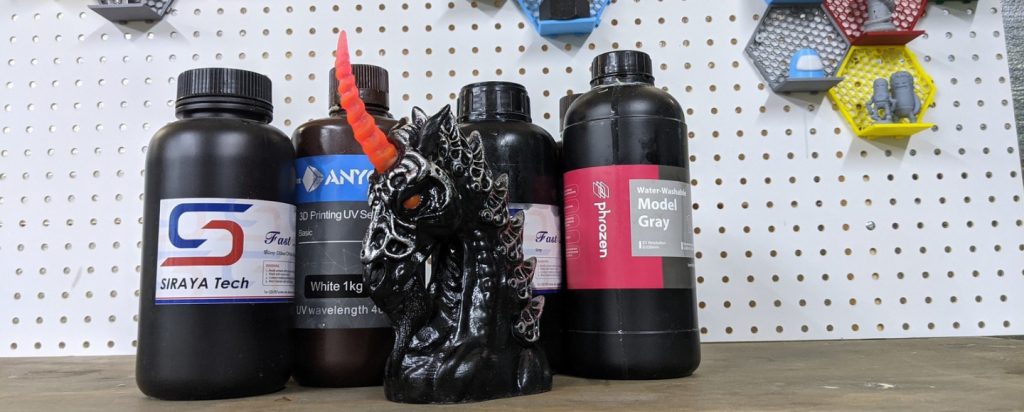
What Is the Best 3D Printer Resin in 2026?
The short answer: Siraya Tech Fast ABS-Like is the best 3D printer resin for most users in 2026. It balances fine detail, structural durability, reliable support behavior, and broad compatibility better than anything else at its price point. But the right resin depends entirely on what you’re printing.
| Use Case | Our Top Pick | Quick Link |
|---|---|---|
| Best Overall | Siraya Tech Fast ABS-Like | Check Price |
| Best for Beginners | Elegoo Standard Resin V3 | Check Price |
| Best for Miniatures | Phrozen Aqua 8K | Check Price |
| Strongest Resin | Siraya Tech Blu Tough | Check Price |
| Best for Jewelry | BlueCast X-One | Visit Official |
| Best Budget Resin | SUNLU ABS-Like | Check Price |
| Best Outdoor Use | Resione TH72 | Check Price |
| Best for Durability | Anycubic Flexible Tough | Check Price |
Why Your Resin Choice Matters More Than Ever
If you’ve ever watched a perfectly detailed miniature shatter the moment you tried to remove its support structures, you already know the truth: your resin matters just as much as your printer. Spend $600 on a Saturn 4 Ultra and feed it garbage resin, and you’ll still get garbage prints. The relationship between machine and material is inseparable — and in 2026, it’s become even more critical.
Modern high-resolution printers — including the Uniformation GK3 Ultra, the Photon Mono M7 Pro, and the Saturn 4 Ultra — push resolutions that older resin formulations simply cannot keep up with. At 12K, 14K, and 16K resolutions, weak resin doesn’t just underperform; it exposes itself. Brittle prints that snap under light pressure. Failed supports that tear layers mid-build. Warped parts that look great on the build plate and catastrophically wrong after curing. Excessive odor that turns your workspace into a chemistry lab. Sticky surfaces that never fully cure no matter how long you blast them with UV.
We tested the best 3D printer resins of 2026 across miniatures, engineering parts, jewelry models, and outdoor exposure tests — and this guide gives you the honest, unfiltered results. No vague impressions. No copying spec sheets. Just real prints, real failures, and real recommendations you can act on today.
How We Tested These 3D Printing Resins
This isn’t a spec-sheet roundup. Every resin in this guide was physically printed and evaluated across multiple categories. Here’s exactly how we did it.
Controlled Temperature Testing: All evaluations were conducted with resin temperature held between 25°C and 30°C using modern vat heaters. Resin viscosity dramatically changes print reliability, and temperature control ensures consistent, accurate results.
Printers Used
- Elegoo Saturn 4 Ultra (16K mono LCD)
- Uniformation GK3 Ultra (12K mono, high-speed capable)
- Anycubic Photon Mono M7 Pro (12K, ACF film, fast peel)
All three printers use modern ACF (Anti-Crystal Film) or PFA release films, which apply significantly more peel force than older FEP setups. This matters enormously: resins that print beautifully on an older Mono X can fail catastrophically on a GK3 Ultra if the formula isn’t optimized for aggressive high-speed peel cycles. We tested for exactly this kind of compatibility.
Temperature-Controlled Testing
All evaluations were conducted with resin temperature held between 25°C and 30°C. This isn’t arbitrary — resin viscosity changes dramatically with temperature. Cold resin (below 20°C) becomes thick and sluggish, leading to poor layer adhesion, failed supports, and incomplete prints. Warm resin flows properly, fills detail cavities cleanly, and produces more reliable support structures. Every resin was temperature-conditioned before printing, which reflects real best practices for enthusiast-level users.
What We Tested
Fine Detail Performance
- Miniature facial features and hair strands
- Fine text legibility at 1mm height
- Sword edges, armor engravings, and filigree
Structural Durability
- Drop tests from 1 meter onto a hard floor
- Flex testing on thin sprues and wrists
- Snap resistance on thin connectors
Support Reliability
- Support tear rates across different geometries
- Suction cupping behavior on large flat surfaces
- Elephant foot at base layers
Odor Evaluation
- Initial print harshness
- Lingering smell after washing and curing
- Relative sensitivity for shared workspaces
Outdoor UV Resistance
- 30-day outdoor exposure test (direct sunlight)
- Pre/post yellowing comparison
- Brittleness assessment after UV exposure
Functional Part Testing
- Snap-fit enclosure clips
- Hinge brackets
- Tool holders under repeated stress
Best 3D Printer Resin Reviews in 2026
Best Overall
Siraya Tech Fast ABS-Like
Best for: Hobbyists, functional prop makers, terrain builders, general printing
- Excellent balance of detail and toughness
- Reliable supports at high print speeds
- Better impact resistance than standard resin
- Forgiving exposure settings
- Not the sharpest for competition-grade miniatures
- Not the strongest for heavy-load mechanical parts
Best for Beginners
Elegoo Standard Resin V3
Best for: New users, those learning dialing-in techniques, budget-focused hobbyists
- Wide exposure tolerance (forgiving for newcomers)
- Low failure rate per bottle used
- Significantly lower odor than V1/V2
- Widely supported community exposure profiles
- Still less impact-resistant than premium ABS-like resin
- Better for display models than mechanical parts
Best for Miniatures
Phrozen Aqua 8K
Best for: Display miniatures, diorama work, competition pieces, collectors
- Unmatched micro-detail resolution
- Exceptional edge sharpness
- Smooth surface finishes
- Expensive premium pricing
- Brittle under impact
If you own a resin printer and you’re not sure what to buy, stop here. Siraya Tech Fast ABS-Like is the best overall 3D printing resin we tested, and it’s not particularly close. It doesn’t win any single category outright — Phrozen Aqua 8K has sharper detail, Siraya Blu Tough has better impact resistance — but it is the only resin that scores very good across every category simultaneously.
What makes it exceptional is the balance. The ABS-like formulation gives prints a slight energy-absorbing flex before breaking, which means a dropped miniature is far more likely to survive on Siraya Fast than on standard resin. Supports release cleanly without tearing surface detail. Layer lines are tight enough for 12K+ printers to resolve fine features, and the default exposure settings are forgiving enough that dialing it in takes minutes rather than hours.
At 25°C–28°C, Siraya Fast flows like cream and layers beautifully. Support reliability in this temperature range is as good as we’ve seen from any resin.
Where It Excels:
- Terrain, props, and cosplay parts that need to survive handling
- General-purpose hobby printing across many model types
- Balanced performance on both budget and premium printers
- Reliable across a wide range of exposure settings
Where It Falls Short:
- Not the sharpest for competition-grade miniatures (use Aqua 8K instead)
- Not the strongest for heavy-load mechanical parts (use Blu Tough instead)
Ideal Exposure Range: 1.8–2.8s at 50–60mW/cm² (varies by printer; run a Cones of Calibration test first)
Best Printer Pairings: Saturn 4 Ultra, GK3 Ultra, Photon Mono M7 Pro, Mono M5s Pro
Recommended Temperatures: 25–30°C for best results
Verdict: If you only buy one resin, make it this one.
Here’s a detail that separates serious reviewers from spec-sheet scrapers: the V3 formulation is dramatically different from Elegoo V1 and V2.
If you tried Elegoo resin a few years ago and gave up because of the brittle snap-failure, the eye-watering odor, or the inconsistent flowability — give V3 a genuine chance. The reformulation addresses all three issues meaningfully. Odor is noticeably lower (though ventilation is still non-negotiable). Flowability has improved so that it levels properly between layers, reducing the “orange peel” texture that plagued earlier versions. And while V3 is still not as tough as a dedicated ABS-like resin, it no longer shatters on contact with a hard floor. Elegoo finally fixed many of the brittleness and harsh chemical odor complaints that made earlier versions infamous among hobbyists.
For beginners, what matters most is a low frustration curve. V3 delivers that. Exposure windows are wide, which means you have more room for error while you’re learning. Support adhesion is consistent. The learning wall you’d normally hit in week two — catastrophic print failures, stuck prints, failed supports — gets pushed back significantly.
The honest tradeoff: V3 is still a display-oriented resin. Prints look beautiful under a light, but they’re not designed for mechanical stress. Don’t print snap-fit clips with it. Don’t use it for props that will be passed around at a convention. But for painted display miniatures, decorative items, and learning the hobby? It’s close to perfect.
Best Beginner Features:
- Wide exposure tolerance (forgiving for newcomers)
- Low failure rate per bottle used
- Available in 1kg and 2kg quantities at accessible prices
- Widely supported community exposure profiles
Recommended Printers: Elegoo Mars 5 Ultra, Anycubic Photon Mono 4, Creality Halot Mage S
Verdict: The most forgiving entry point into resin 3D printing.
Phrozen Aqua 8K is the resin you buy when you want people to lean in and ask, “How did you get that level of detail?” This is premium collector-grade resin, formulated specifically to work with high-resolution LCD panels, and it shows in every print.
Facial features that would blur into approximations on standard resin become genuinely readable on Aqua 8K. Eyelids. Individual teeth. Chainmail rings at 0.3mm diameter. Sword fuller grooves thinner than a human hair. If a 12K or 16K printer can theoretically resolve it, Aqua 8K will give you your best chance of seeing it physically manifest.
The critical tradeoff you need to understand: Aqua 8K achieves that sharpness through a harder, more brittle formulation. Under magnification, the detail is extraordinary. Under a drop test, prints are significantly more fragile than ABS-like resins. A display miniature that will live in a case behind glass? Perfect candidate. A tabletop miniature that will get picked up, put down, and knocked off the table once a week? This is the wrong resin.
For Army Painters and Tabletop Gamers, Consider Instead:
- Siraya Tech Fast Navy Grey — nearly as sharp, much more forgiving of tabletop life
- Elegoo ABS-Like V3 in Grey — great detail with meaningful impact resistance
This is the kind of distinction that separates a genuine buyer’s guide from a generic affiliate roundup. If you’re printing Warhammer 40K minis that will actually get played, the “best miniature resin” headline misses the real question: are you displaying them or playing with them?
Recommended For:
- Competition display pieces
- Highly detailed character busts
- Collector-quality diorama elements
- Printing on 12K+ printers where you need to justify the resolution
Verdict: Competition painters love Aqua 8K, but army painters may prefer something slightly tougher for everyday tabletop handling.
Strongest Resin
Siraya Tech Blu Tough
Best for: Engineering parts, RC components, tool holders, functional brackets, anything that gets hit
- Superior impact resistance
- Absorbs kinetic energy instead of shattering
- Excellent layer adhesion
- Lower surface hardness than standard resin
- Requires dialed exposure settings
Hard Resin vs. Tough Resin: A Critical Distinction
This is the section that most buyers skip, and it costs them. Understanding the difference between hard resin and tough resin will fundamentally change how you shop for 3D printing resin.
Think of it this way: drop a printed miniature sword made from standard resin onto tile, and it snaps at the thinnest point. The same sword in Siraya Blu Tough flexes on impact and lands in one piece. The sword doesn’t look different. It doesn’t feel rubbery. But it has a completely different relationship with kinetic energy.
This distinction matters enormously for functional parts:
- An RC car bracket from standard resin explodes on the first rough landing. The same bracket in Blu Tough survives a dozen crashes.
- A tool holder printed in standard resin cracks when a heavy screwdriver drops into it. In Blu Tough, it doesn’t.
- A snap-fit enclosure in standard resin micro-fractures every time you open it. In Blu Tough, it snaps and releases hundreds of times.
Siraya Tech Blu Tough is the strongest resin for 3D printing in the traditional sense that matters: it absorbs real-world punishment without shattering. It’s not the hardest resin available. It is the most resilient.
Applications:
- Engineering and prototyping
- RC car components and drone frames
- Workshop tool holders and jigs
- Hinged mechanical assemblies
- Anything that will be handled regularly under load
Verdict: When failure is not an option for your functional parts, Blu Tough is the answer.
Best for Jewelry
BlueCast X-One
Best for: Lost-wax casting, professional jewelers, dental models, precision investment casting
- Minimal ash during burnout
- Low shrinkage
- Fine detail retention
- Premium pricing
- Exclusively for casting workflows
Jewelry resin isn’t just “fine detail resin.” It’s an entirely different category with entirely different requirements — and if you’ve ever tried to use a standard hobbyist resin for lost-wax casting, you already understand the frustration of ash residue destroying your mold.
BlueCast X-One is engineered specifically for clean burnout performance. In a jewelry workflow, your printed wax-substitute model goes into an investment mold, which is then fired in a kiln. Standard resins leave carbon residue (ash) behind during burnout, which contaminates your mold and produces defective castings. BlueCast X-One burns out almost completely — with minimal ash residue — leaving clean cavity surfaces that produce crisp, accurate metal castings.
Key Features for Jewelry Work:
- Minimal ash during burnout at standard casting temperatures
- Low shrinkage between digital model and printed output (critical for ring sizing accuracy)
- Fine detail retention comparable to dedicated castable waxes
- Compatible with standard investment casting workflows
Shrinkage Consideration: All resins shrink slightly during photopolymerization. For jewelry applications, you’ll need to scale your digital model upward (typically 0.2–0.5% depending on geometry) to compensate. BlueCast X-One’s shrinkage is among the most predictable of any castable resin, which makes compensating for it straightforward once you’ve run your calibration prints.
Best for Outdoor Use
Resione TH72
Best for: Outdoor decorations, RC car bodies, signage, functional outdoor fixtures, anything that lives in sunlight
- UV-stable elastomer
- Resists cracking and yellowing
- Flexible in thermal cycling
- Niche use case
- Less rigid than standard resin
Most buyers never think about this category until their outdoor print turns yellow, chalky, and brittle after two months on a balcony. Then they learn the hard lesson: standard UV resins are fundamentally incompatible with long-term sunlight exposure.
Here’s why. All standard photopolymer resins cure when exposed to UV light. That same UV sensitivity that makes them cure under your printer’s light source also causes them to continue reacting when placed in sunlight. The result is over-curing: the material becomes progressively more brittle, develops microcracks, and eventually chalks or yellows visibly. A print that looked perfect in March looks ruined by June.
Why Standard Resin Fails Outdoors:
- UV degradation continues post-cure in direct sunlight
- Over-curing causes embrittlement and microcracking
- Thermal cycling (hot days, cool nights) accelerates surface cracking
- Yellowing from photooxidation is essentially unavoidable
Why Resione TH72 Performs Better:
TH72 uses an elastomeric formulation with built-in UV stabilizers. The slight flex in the cured material is key: when thermal cycling causes expansion and contraction, a rigid standard resin develops stress cracks. TH72’s slight give absorbs that movement without cracking. The UV stabilizers slow photooxidation, meaning yellowing and embrittlement happen over years rather than months.
In our 30-day outdoor exposure test, TH72 prints showed minimal yellowing and no cracking. Standard resin control prints showed visible yellowing at 3 weeks and surface cracking at 5 weeks.
Extend Outdoor Life Further — Recommended Accessories:
Add a sacrificial UV-absorbing layer over your prints to dramatically extend outdoor life.
Best Budget
SUNLU ABS-Like
Best for: High-volume printing, cost-conscious hobbyists, paint-and-play miniature gamers, prototyping
- Exceptional value
- Improved batch consistency in 2026
- Good impact resistance for the price
- Doesn’t match premium detail
- Support reliability slightly behind Siraya
Let’s be honest about budget resin history: SUNLU’s earlier ABS-like formulations had real problems. Color inconsistency between bottles was a genuine issue — your grey prints in bottle one looked noticeably different from bottle two. Reviewers called it out, and it deserved the criticism.
Here’s what’s changed in 2026: SUNLU has fixed it. Batch consistency has improved significantly, to the point where we’re now recommending SUNLU ABS-Like as the best budget 3D printer resin without qualification. The old color inconsistency complaints? We didn’t reproduce them in current stock.
More importantly, the impact resistance to price ratio on SUNLU ABS-Like is genuinely exceptional. It often undercuts Anycubic’s comparable formulations by 15–25% per kilogram while delivering very similar structural performance. For hobbyists printing large volumes of miniatures, terrain, or display pieces where cost per print matters, SUNLU is the smart choice.
Current SUNLU ABS-Like Strengths:
- Improved batch-to-batch color consistency
- Excellent impact resistance for the price point
- Good surface finish with minimal layer line visibility
- Wide compatibility across consumer resin printers
The Honest Caveat: SUNLU ABS-Like still doesn’t match Siraya Tech Fast in support reliability or Phrozen Aqua 8K in raw detail. But for the price? It’s not supposed to. It just needs to produce good prints reliably at a low cost — and it does.
Best for Durability
Anycubic Flexible Tough Resin
Best for: Wearable props, cosplay armor, phone cases, bendable mechanical parts, repeated-impact applications
- Absorbs impact beautifully
- Holds shape under handling
- Survives repeated flexing
- Not truly rubber-like
- Requires specific exposure tuning
Anycubic Flexible Tough sits in a distinct niche: it’s not quite a standard ABS-like resin, and it’s not a fully flexible TPU-equivalent elastomer. It occupies the useful middle ground between the two, combining impact absorption with enough rigidity to hold shape under normal handling.
For wearable cosplay props, this is close to ideal. Rigid armor pieces shatter the first time you bump against a doorframe at a convention. Fully flexible pieces flop and don’t hold their sculpted form. Anycubic Flexible Tough holds its shape, survives contact, and doesn’t delaminate at the layer boundaries when bent repeatedly.
Where It Excels:
- Wearable armor and prop costume pieces
- Phone cases and consumer product mockups
- Snap-fit parts that need to survive thousands of cycles
- Anything that gets flexed, dropped, or sat on
Advanced: Mixing Flexible Resin for Custom Toughness
One of the most underappreciated techniques in resin printing is resin mixing. By combining a flexible resin like Anycubic Flexible Tough with a standard ABS-like resin, you can tune toughness and flexibility to your exact requirements.
| Mix Ratio (Flexible:ABS-Like) | Result |
|---|---|
| 10:90 | Slightly tougher ABS-like with better snap resistance |
| 25:75 | Noticeably flexible, good for thin walled parts |
| 50:50 | Semi-flexible, suitable for soft armor and gaskets |
| 75:25 | Mostly flexible, retains basic printability |
Notes on Mixing:
- Always mix by weight, not volume, for consistency
- Thoroughly shake both bottles before combining
- Test exposure settings with a calibration print — mixed resins often need adjusted exposure times
- Mixing resins from different manufacturers can produce unpredictable results; test first in small batches
This technique is advanced enthusiast territory that competitors consistently skip — and it genuinely expands what you can do with a single printer.
Best 3D Printer Resin Comparison Table
| Resin | Best Use | Toughness | Detail Quality | Odor Level | Print Ease | UV Resistance | Relative Price |
|---|---|---|---|---|---|---|---|
| Siraya Tech Fast ABS-Like | All-purpose | ★★★★☆ | ★★★★☆ | Moderate | ★★★★★ | ★★★☆☆ | Mid |
| Elegoo Standard Resin V3 | Beginners, display | ★★★☆☆ | ★★★★☆ | Low-Moderate | ★★★★★ | ★★☆☆☆ | Budget |
| Phrozen Aqua 8K | Display miniatures | ★★☆☆☆ | ★★★★★ | Moderate | ★★★★☆ | ★★☆☆☆ | Premium |
| Siraya Tech Blu Tough | Functional parts | ★★★★★ | ★★★☆☆ | Moderate | ★★★★☆ | ★★★☆☆ | Mid |
| BlueCast X-One | Jewelry casting | ★★★☆☆ | ★★★★★ | Low | ★★★☆☆ | N/A | Premium |
| Resione TH72 | Outdoor use | ★★★★☆ | ★★★☆☆ | Low-Moderate | ★★★☆☆ | ★★★★★ | Mid |
| SUNLU ABS-Like | Budget printing | ★★★★☆ | ★★★☆☆ | Moderate | ★★★★☆ | ★★☆☆☆ | Budget |
| Anycubic Flexible Tough | Wearables, props | ★★★★★ | ★★★☆☆ | Moderate | ★★★☆☆ | ★★★☆☆ | Mid |
How to Choose the Best 3D Printer Resin
Standard vs. ABS-Like vs. Tough vs. Flexible Resin
The resin market has splintered into specialized categories, and the right choice depends entirely on your application. Here’s a plain-English breakdown:
Standard Resin
The original photopolymer formula. High surface hardness, excellent detail clarity, sharp edges, low shrinkage. The catch: it’s genuinely brittle. Prints snap under moderate impact. Best for display pieces that won’t be handled or dropped.
ABS-Like Resin
Formulated to mimic the properties of ABS thermoplastic. Slightly lower hardness than standard, but meaningfully better impact resistance. The best all-around choice for hobbyists who want decent detail and survivable prints. Siraya Tech Fast, SUNLU ABS-Like, and Elegoo ABS-Like V3 are all in this category.
Tough Resin
High-elongation formulas engineered to absorb impact energy without shattering. Lower surface hardness than ABS-like, but dramatically better performance under real mechanical stress. Think of it as the engineering-grade tier. Siraya Tech Blu Tough is the best example.
Flexible Resin
Elastomeric formulations that bend rather than break. Not truly rubber-like, but can handle significant deflection. Ideal for gaskets, soft armor, flexible connectors, and wearable pieces. Best used in blends with stiffer resins to find your desired flex point.
Castable Resin
Specialty formulas designed to burn out cleanly in investment casting molds. Not for general printing. Exclusively for jewelry, dental, and precision casting workflows. BlueCast X-One is the category leader.
High-Temperature Resin
Engineered to maintain structural integrity above 100°C. Used for engineering prototypes that need to survive heat testing. Not covered in this guide but worth knowing exists.
Water-Washable Resin vs. IPA-Wash Resin
Water-washable resins sound like a dream: clean up your prints under the tap, no IPA needed, no chemical handling. In practice, it’s more complicated — and there’s an important safety point most guides bury or omit entirely.
Washing your prints in your kitchen sink, bathroom basin, or garden hose produces resin-contaminated water that is harmful to aquatic life and potentially illegal to discharge in many regions. Do not pour resin wash water down the drain.
Proper disposal:
- Collect all contaminated wash water in a clear container
- Leave it in direct sunlight or cure it with a UV lamp until fully solid
- Dispose of the cured solid in your regular household waste (check local regulations)
- For large volumes, use a designated hazardous waste facility
Water-washable resins do have genuine advantages: they’re lower-odor on average, they reduce chemical storage requirements, and they’re slightly more forgiving for workspace setups without dedicated IPA ventilation. For beginners with limited space, they’re a legitimate choice. Just go in with accurate expectations about what “washable” actually means.
Resin Safety and Ventilation
Uncured photopolymer resin is classified as a skin sensitizer and potential respiratory irritant. This isn’t scare-mongering — it’s practical information that should shape your workspace setup from day one.
Non-Negotiable Safety Basics:
- Nitrile gloves — always, for every print removal, vat cleaning, and bottle handling. Resin skin sensitization is cumulative; once sensitized, even minor exposure can trigger reactions.
- Eye protection — splash-rated safety glasses when handling liquid resin or cleaning vats.
- Ventilation — active airflow moving away from your breathing zone. At minimum, a box fan exhausting to outside. Ideally, a carbon-filter ventilation enclosure.
- Respirator — for extended printing sessions or high-volume users, a half-mask respirator with OV/P100 cartridges is appropriate.
Curing Safety:
- Always cure prints in a dedicated wash-and-cure station, not in sunlight where you’ll be present
- Fully cured resin is inert and safe to handle without gloves
- Uncured resin on skin should be removed immediately with isopropyl alcohol before washing with soap and water (water alone can drive uncured resin into skin pores)
Why Exposure Calibration Matters More Than Expensive Resin
Here’s an uncomfortable truth: buying premium resin will not save bad exposure settings. A $60/kg Phrozen specialty resin printed with wrong exposure times will look worse than SUNLU budget resin dialed in correctly.
Essential Calibration Tools:
- Cones of Calibration (Ameralabs) — the most widely used calibration print for dialing in base layer count, exposure time, and lift speeds
- AmeraLabs Town — a more comprehensive test print that evaluates overexposure, detail resolution, and support reliability simultaneously
- Resin Manufacturer Profiles — most premium brands publish printer-specific exposure profiles; always start here rather than guessing
Temperature’s Role:
Resin exposure windows shift with temperature. At 18°C, a resin that needs 2.2s exposure may need 2.5–2.8s due to increased viscosity and slower photopolymerization rate. At 30°C, the same resin may only need 1.8s. If your prints are inconsistent between sessions and you’re in a climate with temperature swings, temperature is often the invisible culprit.
Resin Shelf Life and Storage
How Long Does Resin Last?
Most photopolymer resins have a stated shelf life of 12 months from manufacture. In practice, properly stored resin can remain usable well beyond that — and improperly stored resin can go bad in weeks.
Proper Storage:
- Keep bottles upright in a cool, dark location — a cabinet away from windows is ideal
- Temperature: 15–25°C is the target range; avoid freezing or extended heat above 30°C
- Light: even ambient room light degrades resin slowly; opaque bottles matter, and exposure to sunlight through a window can ruin a partially used bottle quickly
- Pigment separation is normal — dense pigments sink over time. Shake bottles thoroughly (minimum 60 seconds) before every use. If a bottle has been sitting for months, roll it between your palms to warm it slightly before shaking
Signs of Degraded Resin:
- Gelled or stringy consistency that doesn’t shake back to fluid
- Strong chemical smell change (different from normal resin odor)
- Prints that fail consistently despite correct exposure settings
Best 3D Printer Resin Brands in 2026
Not all resin brands are created equal. Marketing claims are cheap. Batch consistency is what actually matters when you’re six prints deep into a project.
Premium Tier
Siraya Tech — Consistently the most trusted brand among experienced users. Their formulations are well-documented, community-tested exposure profiles exist for every major printer, and batch-to-batch consistency is genuinely excellent. If you want to print serious work without playing lottery with settings, Siraya Tech is where to start.
Phrozen — Premium pricing, premium results. Phrozen’s specialty resins like Aqua 8K are designed explicitly for their own printer lineup but work well broadly. Best for users who know they want maximum detail and are willing to pay for it.
AmeraLabs — Smaller batch sizes, higher prices, but exceptional formulations for professional applications. Their calibration tools (including the AmeraLabs Town test print) are used as industry standards. A brand for serious enthusiasts and professionals.
Best Value Tier
SUNLU — The 2026 reformulations have significantly closed the quality gap with mid-tier brands at budget prices. High-volume hobbyists who print constantly and care about cost per print have moved heavily toward SUNLU.
Elegoo — Consistent improvement from V1 through V3. Elegoo’s ecosystem advantage is massive: their resins come with published exposure profiles for every Elegoo printer, creating a smooth out-of-the-box experience. Slightly less refined than Siraya but excellent value.
Anycubic — Similar ecosystem logic to Elegoo. Anycubic resins work seamlessly on Anycubic printers and are reliably available. Quality is mid-tier and pricing is competitive.
Specialty Tier
BlueCast — The castable resin category leader for jewelry and precision casting. Not a general-purpose brand; do not buy it unless you have an investment casting workflow. In that context, nothing else comes close.
Resione — Niche but genuinely excellent for outdoor and elastomeric applications. TH72 is the best outdoor UV-resistant resin available and worth the targeted purchase if that’s your application.
Liqcreate — European brand with excellent engineering-grade resins. Strong technical documentation, excellent for professional prototyping applications. Less commonly available in North American retail channels.
Common Resin Printing Problems (And How to Fix Them)
Why Are My Resin Prints Brittle?
The most common reason for brittle prints is using standard resin for applications that need ABS-like or tough resin. Standard resin is genuinely brittle by design — it’s optimized for hardness and detail, not impact resistance. If your parts need to survive handling, upgrade to an ABS-like formulation.
Secondary causes include overcuring, which drives additional crosslinking that stiffens and embrittles the material. If your current settings work for Phrozen Aqua 8K but your prints still snap, try reducing exposure time by 10–15% and retesting.
Why Are My Resin Prints Cracking?
Cracking typically falls into two categories:
Cracking during printing is almost always a support failure or adhesion issue. The partially cured print is flexed by peel forces and fractures without enough support material to hold it. Fix: increase support density, add manual supports at stress points, slow down lift speed.
Cracking after printing — especially on outdoor prints or prints exposed to sunlight — is UV degradation. Standard resin continues to cure and embrittle in sunlight. Fix: apply a UV-protective clear coat immediately after curing, or switch to a UV-stable formulation like Resione TH72 for any outdoor application.
Why Are My Supports Failing?
Support failures are among the most frustrating resin printing problems and have several common causes:
- Resin temperature too low — cold resin is viscous and doesn’t flow well around fine support tips. Warm your resin to 25°C+.
- Support tip diameter too small — in auto-generated supports, tip diameter controls adhesion to the part surface. For larger, heavier parts, increase tip diameter.
- Lift speed too fast — aggressive ACF/PFA film peel can literally rip supports off the build plate. Slow your initial lift speeds.
- Resin mismatch with film type — some resins are optimized for FEP and struggle with ACF/PFA release behavior. Check if your resin has ACF-specific exposure profiles.
Why Is My Resin Sticky After Curing?
A tacky surface after curing means one of three things:
- Insufficient UV exposure during curing — the surface layer hasn’t fully crosslinked. Solution: cure longer, or cure in direct sunlight supplemented by a UV lamp.
- Oxygen inhibition layer — the outermost surface of any resin print is slightly inhibited by oxygen during the cure cycle, leaving a thin tacky layer. This is normal and harmless; it wipes off with IPA.
- Contaminated wash solution — if your IPA or wash water is saturated with dissolved resin, it’s redepositing uncured material onto your prints. Replace your wash solution.
Why Does My Resin Smell So Strong?
All uncured photopolymer resins contain volatile organic compounds (VOCs) that produce odor. That said, some resins smell dramatically worse than others.
Lower-odor formulations to consider:
- Elegoo Standard Resin V3 (significantly lower odor than V1/V2)
- Most water-washable resins (generally lower-odor due to different solvent profiles)
- Siraya Tech ABS-Like (moderate odor, better than most standard resins)
If odor is a primary concern:
- Active carbon filtration is significantly more effective than passive ventilation alone
- An enclosure with a carbon-filter exhaust fan will contain most resin VOCs
- Never rely on ventilation alone — use nitrile gloves to prevent skin absorption of odor-causing compounds
Why Are My Resin Prints Warping?
Warping in resin printing is less common than in FDM but still occurs. Primary causes:
- Insufficient base layer exposure — base layers need to be significantly overexposed to adhere strongly to the build plate. Standard base layer times are typically 5–10x normal layer exposure.
- Too many base layers — paradoxically, excessive base layers can increase warping stress at the transition point. Standard 3–6 base layers is usually correct.
- Large flat surfaces without holes — suction cup effect during peel creates massive tensile forces. Add drain holes to any large flat surfaces over 5cm².
- Thermal gradient — printing in a cold room where the build plate warms and the vat stays cold creates differential cure rates. Keep resin warm and consistent throughout the print.
Essential Accessories for Resin Printing
The right accessories dramatically reduce frustration and improve safety. These are the items serious resin printers consider non-optional:
Wash and Cure Station
Combined wash-and-cure stations simplify the post-processing workflow dramatically and ensure consistent curing results. Curing time is predictable, odor is contained, and your IPA stays in an enclosed chamber.
Nitrile Gloves (Box of 100)
Buy gloves by the box, not by the pair. You’ll burn through more than you expect. Nitrile specifically — not latex (can degrade with resin solvents) and not vinyl (insufficient chemical resistance).
Silicone Mat
A silicone work mat under your printer and at your cleaning station catches spills before they reach your work surface. Cured resin peels off silicone cleanly; cleaning resin from an unprotected table is significantly less fun.
UV Flashlight (365nm)
A 365nm UV flashlight is the most useful diagnostic tool in a resin printer’s kit. Use it to find uncured resin spots, check cure completeness, and spot resin contamination on work surfaces in a dark room.
Resin Filters (Paint Strainer Bags)
Always filter your resin back into the bottle after printing. Cured resin flakes and failed layer remnants that fall back into your vat destroy subsequent prints. Disposable paint strainer bags (same product used for filtering paint) work perfectly.
Respirator with OV/P100 Cartridges
For extended sessions or small workspaces, a proper half-face respirator provides meaningful protection that an N95 dust mask does not. VOCs pass right through N95 filtration; only activated carbon OV cartridges capture them.
Flexible Build Plate
If your printer doesn’t include a flexible steel build plate, this is one of the highest-value upgrades available. Prints release with a gentle flex rather than a pry — dramatically reducing broken parts and damaged build surfaces.
7 Resin Printing Tips Most Beginners Learn Too Late
1. Warm resin prints better. Cold resin is the silent killer of otherwise good print jobs. If your workshop is cool, warm your resin bottle in a water bath at 30°C for 20 minutes before printing. You will see an immediate improvement in support reliability and surface quality.
2. Overcuring makes prints brittle. More UV is not always better. Once a layer is fully cured, additional exposure time is wasted at best and damaging at worst. Over-cured prints are measurably more brittle than correctly cured ones.
3. Hollow your large models. Solid prints use dramatically more resin, increase print time, add peel force stress, and — ironically — often print worse than hollow models due to suction cup effects. For any model larger than a golf ball, hollow it out with 1.5–2mm walls and add 2–3 drain holes at the lowest points when oriented for printing.
4. Drain holes need to be in the right location. A drain hole in the wrong place doesn’t drain. When orienting your hollow model for printing, identify where liquid resin will pool (the lowest points of internal cavities at print orientation) and place drain holes there specifically.
5. Shake your bottles thoroughly. Resin pigments and density modifiers are denser than the base monomer and settle over time. Inadequate shaking is behind a surprising proportion of “bad batch” reports. Shake vigorously for a full 60 seconds before every bottle use, regardless of how recently you used it.
6. Separation in the bottle is normal, not spoilage. First-time users who see a settled layer of pigment at the bottom of the bottle sometimes assume the resin has gone bad. It hasn’t. All resin separates over time. The shaking protocol above resolves it completely.
7. Support density matters more than support size. Beginners often focus on support tip size and column diameter. The more impactful variable is support density — how many supports are carrying the print’s weight. Err toward more, smaller supports rather than fewer, larger ones. More contact points distribute load more effectively.
Frequently Asked Questions
What is the best 3D printer resin overall?
Siraya Tech Fast ABS-Like is the best all-purpose 3D printer resin in 2026. It delivers a balance of detail quality, structural toughness, support reliability, and broad printer compatibility that no other single resin matches at the same price point.
What resin is best for miniatures?
Phrozen Aqua 8K delivers the best detail resolution for display-quality miniatures. For miniatures that will be played on a tabletop and need to survive drops, Siraya Tech Fast Navy Grey or Elegoo ABS-Like V3 Grey are more practical choices.
What is the strongest resin for 3D printing?
Siraya Tech Blu Tough. It’s not the hardest resin (hardness and toughness are different properties), but it offers the best real-world impact resistance and survivability under mechanical stress. If you need parts that don’t shatter, Blu Tough is your answer.
What is the best resin for functional parts?
For functional, structural parts, Siraya Tech Blu Tough is the top choice. For lighter-duty functional use, Siraya Tech Fast ABS-Like is more forgiving and easier to print.
Is water-washable resin safer than standard resin?
Not inherently. Water-washable resin is still toxic when uncured and should never be washed down a drain. The contaminated wash water must be cured under UV light before disposal. The only genuine advantage is eliminating IPA storage and handling.
Which resin smells the least?
Elegoo Standard Resin V3, most water-washable resins, and BlueCast X-One are among the lower-odor options. That said, all uncured photopolymer resins require ventilation regardless of perceived odor level — low smell does not mean low VOCs.
Can resin prints survive outdoors?
Standard resin prints do not hold up well to extended outdoor exposure. Resione TH72 is specifically engineered for UV stability and is the best outdoor 3D printing resin currently available. Pairing any resin with a UV-resistant clear coat extends outdoor life significantly.
How long does resin last?
Properly stored (cool, dark, sealed), most resins remain usable for 12–18 months from manufacture. Improperly stored resin (exposed to light or heat) can degrade much faster. Resin that has gelled or changed consistency should be discarded.
Can you mix different resins together?
Yes, and it’s a powerful technique. The most common approach is mixing a flexible resin into an ABS-like resin at 10–25% to improve impact resistance without sacrificing printability. Always mix by weight, adjust exposure settings for the blend, and test with calibration prints before committing to a full project.
What resin do jewelers use?
Professional jewelers use castable resins engineered for clean burnout in investment casting. BlueCast X-One is the leading recommendation for clean burnout performance, minimal ash residue, and dimensional accuracy in metal casting workflows.
Is ABS-like resin worth it?
Yes, for almost every use case outside of pure display printing and jewelry casting. ABS-like resin costs nominally more than standard resin and delivers meaningfully better impact resistance, support behavior, and real-world durability. For most hobbyists, ABS-like should be the default choice rather than standard resin.
Conclusion: The Right Resin for the Right Job
There’s no single best 3D printer resin — but there is a best resin for you, based on what you actually print.
- Best overall for most users: Siraya Tech Fast ABS-Like — balanced, reliable, versatile
- Best for complete beginners: Elegoo Standard Resin V3 — forgiving, affordable, widely supported
- Best for premium detail work: Phrozen Aqua 8K — unmatched resolution for display-quality miniatures
- Best for durability and functional parts: Siraya Tech Blu Tough — genuine toughness for real-world mechanical stress
- Best for outdoor applications: Resione TH72 — the only formula we’d trust in direct sunlight long-term
The printers have never been better. The resins have genuinely caught up. In 2026, the biggest mistake you can make isn’t buying the wrong printer — it’s buying the wrong resin for a perfectly good one.
Pick the right material, calibrate your exposure settings, keep your resin warm, and you’ll be stunned by what a modern resin printer is capable of.
Ready to Upgrade Your Resin?
The best resin is the one that matches your application—not the most expensive bottle. Check out our top picks and start printing better today.
All products in this guide were independently tested. Recommendations reflect our genuine findings. We may earn a commission on qualifying purchases made through our links at no additional cost to you.
Looking for the best 3D printer resin for various models, such as miniatures, cookie cutters, dental models, and so on? Read our guide for the resins we recommend.
Below are examples of models printed using the Esun Standard Resin.


Deadpool figurine

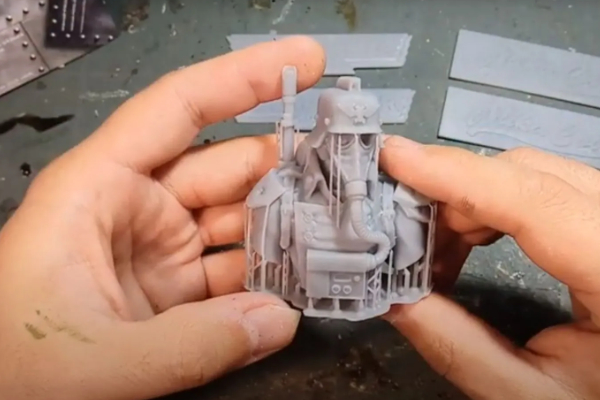
Bust of a military man

Howl’s Moving Castle, miniature
Check below examples of models printed using the EResin-PLA .

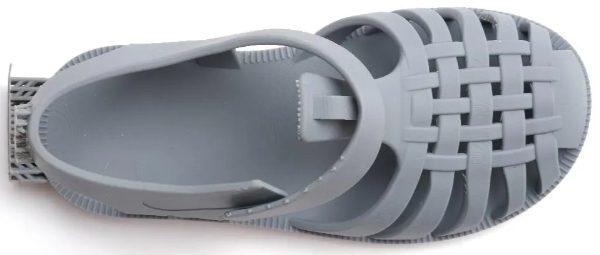
Shoe mockup
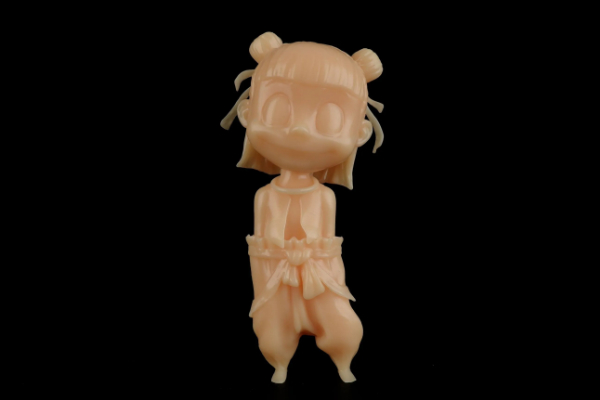
Cartoon girl figurine
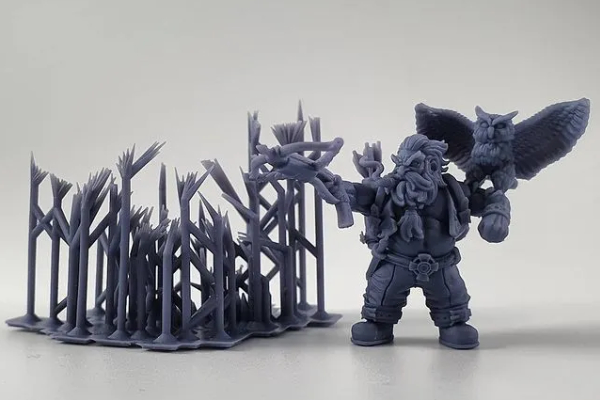
Game miniature


Custom lens focusing rings
3. Phrozen Aqua 4K
Phrozen Aqua 4K is designed specifically to unleash the full potential of 4K resin 3D printers. Prints made by this resin experience almost not shrinkage.
The resin works well for accurate printing of decorative patterns. However, to take advantage of all properties of the resin, you need to use a high-resolution printer, such as the Sonic Mini 4K or the Sonic Mighty 4K.
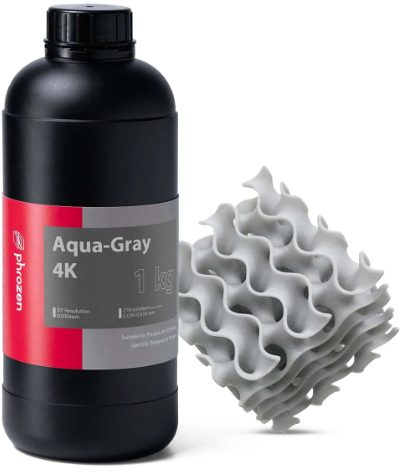

AVAILABLE ON PHROZEN
Specifications
- Print technology: DLP/LCD/LED
- UV wavelength: 395-405 nm
- Shore hardness: 77 D
- Color palette: gray, ivory.
- Volume: 1 kg
Below are sample models printed by the Phrozen Aqua 4K resin.

Phrozen Aqua 4K Gray Resin Armor

Predator bust

Figurine war with a bear
Below are examples of models printed using Phrozen Beige Low-Irritation resin.


Decorative figurine

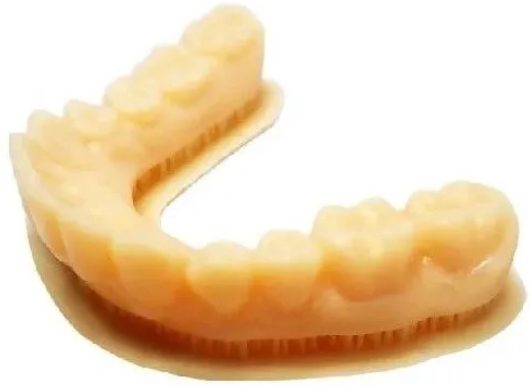
Jaw
See the print examples made using the ESUN Precision Model resin.
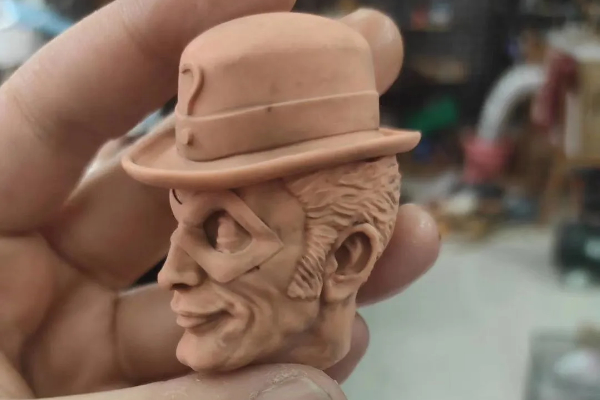
DC Riddler Head


Miniature ICE model

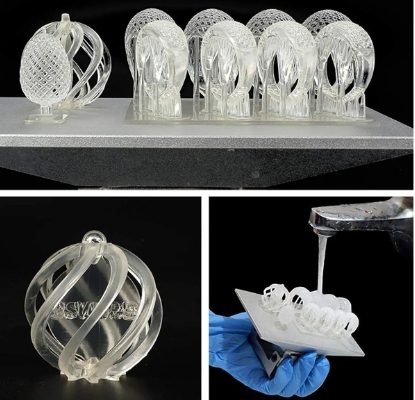
Rings and pendant printed with transparent ESUN Water Washable


Fox figurine
2. Phrozen Water Washable
Phrozen Water Washable resin compares favorably with other water washable resins in terms of strength, durability and short exposure time of the layer.
The resin is suitable for making prototypes and other models at home and in educational institutions, where it is undesirable to use strong smelling alcohols for rinsing.

AVAILABLE ON PHROZEN
Specifications
- Print technology: DLP / LCD / LED
- UV wavelength: 405 nm
- Shore hardness: 80 D
- Color palette: gray, black.
- Volume: 1 kg
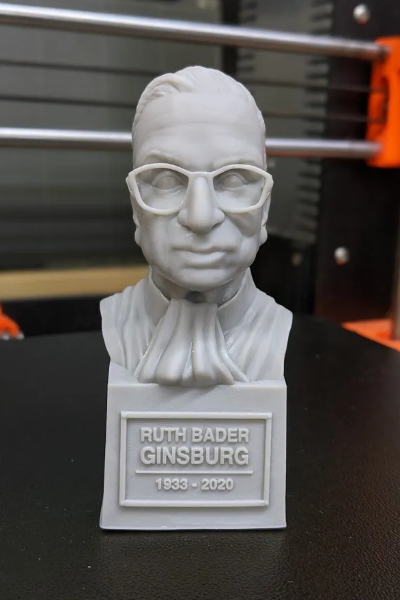
Bust made from Phrozen Water Washable


Alien, printed from Phrozen Water Washable


Spiderman bust
Here are some models made using the Wanhao Water Washable resin:


Han Solo from transparent Wanhao Water washable
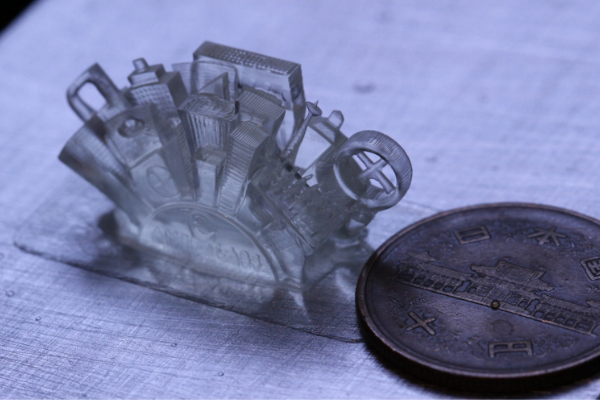
Test model made of transparent Wanhao Water washable

Test models in different colors Wanhao Water washable
Engineering
Previously, resin 3D printers were mainly used for making master models and products with high precision. Today, they are used for a wide range of tasks. The printers can make ready-made, functional model at once. This is possible thanks to engineering resins with improved characteristics.
Depending on the application, the resin can be harder, more heat resistant and more durable than standard resins.
Reinforced Resins
These are resins with improved characteristics – for example, high heat resistance or impact resistance. The resins can be used to make functional prototypes, engineering models, and so on.
Below are the best reinforced resins.
1. Phrozen TR250-LV
The Phrozen TR250-LV has is specifically designed for engineering applications . In addition to high strength and hardness, the resin has increased heat resistance. It can withstand heating up to 150 degrees.
Phrozen TR250-LV is suitable for printing models for subsequent thermoforming or products that require increased heat resistance.


AVAILABLE ON PHROZEN
Specifications
- Print technology: DLP/LCD/LED
- UV wavelength: 405 nm
- Shore Hardness: 79D
- Tensile strength 25 MPa
- Impact strength according to Izod: 6.31 kJ / m2
- Color palette: gray
- Volume: 1 kg
See the print examples made using the Phrozen TR250-LV:

Jaw layout

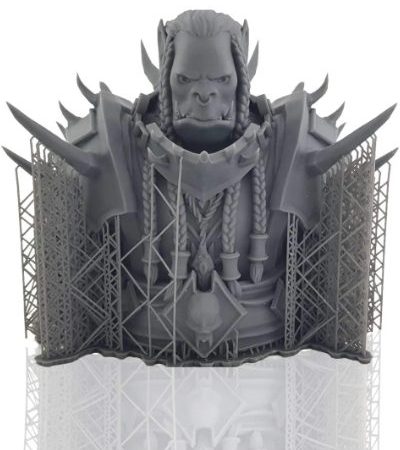
Orc bust
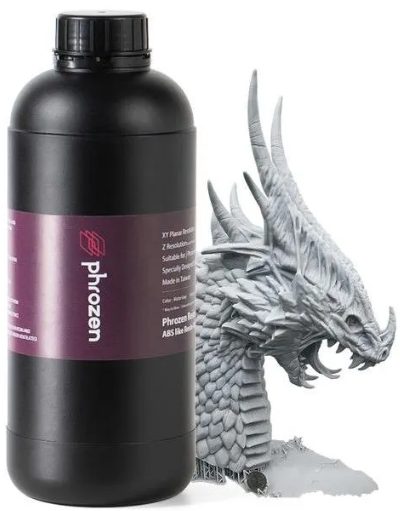
2. Phrozen ABS-like
The Phrozen ABS-like resin has characteristics similar to ABS plastic, which is a common type of filament used in FDM printing. The palette has a white color, this allows, if necessary, to easily paint the finished product.
This resin is suitable for printing functional models and prototypes.

AVAILABLE ON PHROZEN
Specifications
- Print technology: DLP/LCD/LED
- UV wavelength: 405 nm
- Shore Hardness: 79D
- Izod impact strength: 2.32 kJ / m2
- Color palette: gray, white
- Volume: 1 kg
Here are example prints made using the resin:

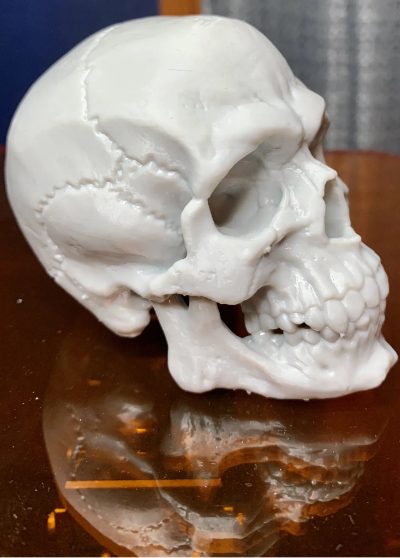
Skull model


Miniature figurine weapons

1/4 part of the mask
3. Phrozen Rock-Black Stiff
Rock-Black Stiff is strong, wear resistance and heat resistance (up to 97 degrees). The models made using the resin are durable and slightly flexible to withstand shock loads.


AVAILABLE ON PHROZEN
Specifications
- Print technology: DLP/LCD/LED
- UV wavelength: 405 nm
- Shore Hardness: 81D
- Elongation at break: 4%
- Impact strength according to Izod: 2.68 kJ / m2
- Color palette: black
- Volume: 1 kg
Below are some sample models printed using the resin:


Elf bust

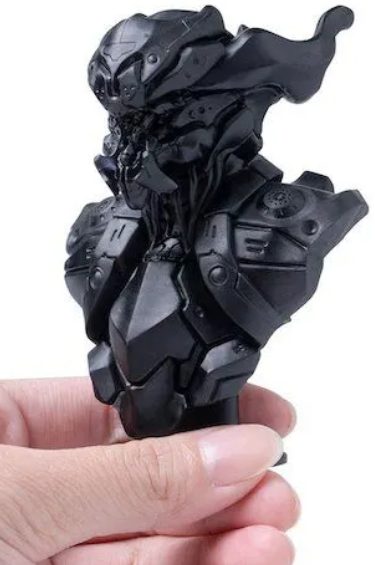
Bust printed from Phrozen Rock-Black Stiff
4. Phrozen Nylon Green Tough
Phrozen Nylon Green Tough resin is comparable to nylon in certain aspect. Nylon is a tough and durable material that is commonly used in FDM printing. Products made from the resin are very durable and resistant to stress. The finished models can also be folded.
This resin is suitable for the manufacture of finished products or functional prototypes.


AVAILABLE ON PHROZEN
Specifications
- Print technology: DLP / LCD / LED
- UV wavelength: 405 nm
- Shore Hardness: 68D
- Elongation at break: 130%
- Tensile strength: 19 MPa
- Impact strength according to Izod: 23.79 kJ / m2
- Color palette: green
- Volume: 1 kg
Below are some sample models made using the Phrozen Nylon Green Tough resin:


Phrozen Nylon Green Tough Vase

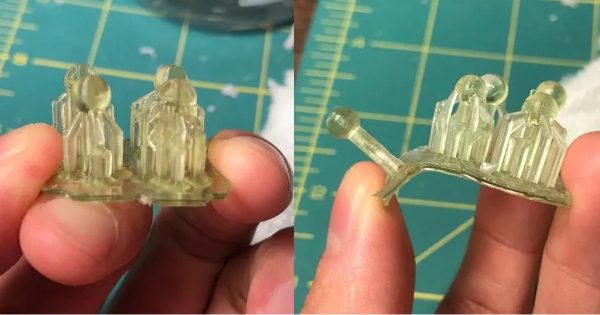
Test model

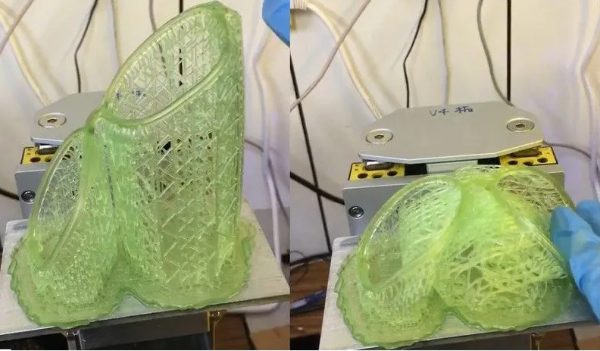
Frame for glasses
5. Phrozen TR300 Ultra-High Temp
TR300 Ultra-High Temp allows you to quickly produce durable, impact and heat resistant products (up to 160 degrees). The resin compares favorably with its competitors by its short exposure time (1.3 seconds per layer on Phrozen Sonic series 3D printers).
This resin is suitable for the manufacture of heat-resistant and durable products. For example, a model for subsequent thermoforming or the manufacture of an industrial model.


AVAILABLE ON PHROZEN
- Print technology: DLP / LCD / LED
- UV wavelength: 405 nm
- Shore Hardness: 80D
- Tensile strength: 32 MPa
- Impact strength according to Izod: 8 kJ / m2
- Elongation at break: 2%
- Color palette: gray
- Volume: 1 kg
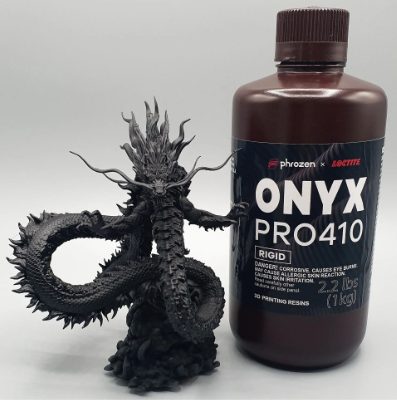
6. Phrozen Onyx Rigid Pro410
The main properties of the models made of Onyx Rigid Pro410 are amazing details and durability. The resin was developed in partnership with Henkel and is intended primarily for home use.
This resin is perfect for models with a lot of small details. It can also be used for engineering or functional models where high precision and durability are important.

AVAILABLE ON PHROZEN
Specifications
- Print technology: DLP / LCD / LED
- UV wavelength: 405 nm
- Color palette: Black
- Volume: 1 kg
See some sample models printed using the resin:

Tablet stand


Fruit bowl

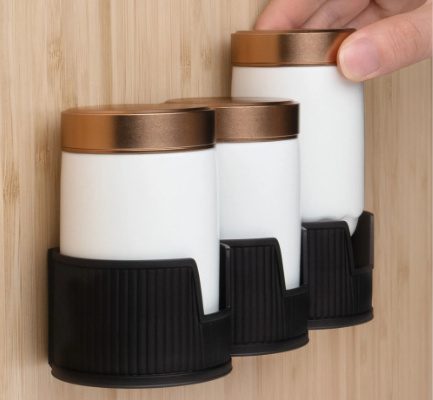
Wall mounted spice holder

Wall hanger
Flexible
Products made from flexible resins are similar to silicone or rubber. These resins produce flexible and durable functional products that are resistant to tearing.
Below are the best flexible resins on the market:
1. Phrozen Biege Flex
Phrozen Biege Flex is designed for products that need to be strong and slightly pliable. The resin is suitable for functional models that need a little flexibility.


AVAILABLE ON TOP3DSHOP
Specifications
- Print technology: DLP / LCD / LED
- UV wavelength: 405 nm
- Shore Hardness: 65D
- Tensile strength: 40 MPa
- Elastic modulus: 192 MPa
- Color palette: beige
- Volume: 0.5kg
See sample models made using the resin:

Harley Queen bust


Miniature from Phrozen Biege Flex

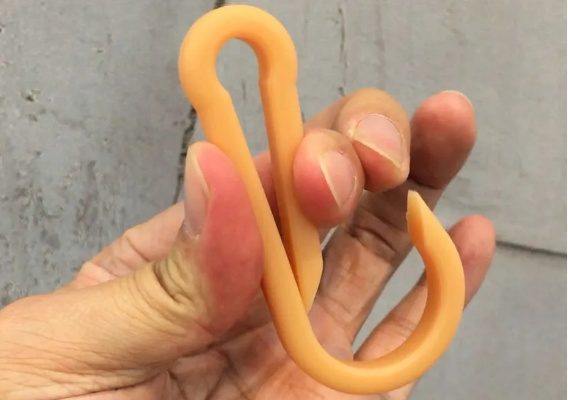
Functional carbine
2. HARZ Labs Industrial Flex
The properties of finished products from HARZ Labs Industrial Flex are similar to polyurethane. Products from it are elastic and very durable.
HARZ Labs Industrial Flex is suitable for the manufacture of gaskets or any other model where softness and tensile strength are important.
Industrial Flex can be used as an additive for other HARZ Labs resins. This improves the flexibility and strength of the finished model.
Depending on the resin ratio, varying degrees of flexibility can be achieved in the finished product.


AVAILABLE ON HARZ LABS
Specifications
- Print technology: DLP / LCD / LED
- UV wavelength: 405 nm
- Shore Hardness: 63D
- Shrinkage: 0.5%
- Elongation at break: 103%
- Tensile strength: 13 N / mm2
- Color palette: transparent
- Volume: 0.5kg 1kg
Here are some models printed using the resin:

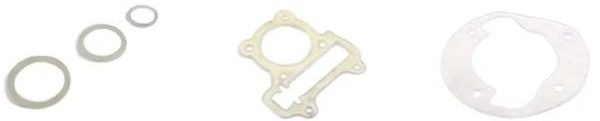
Various gaskets printed from HARZ Labs Industrial Flex
3. ESUN Flex
ESUN Flex is a flexible and durable resin with good wear resistance. Good tensile strength and accuracy make the resin suitable for engineering models.
You can use the resin for products that must be strong and flexible at the same time. These can be engineering prototypes or functional models.


AVAILABLE ON MATTERHACKERS
Specifications
- Print technology: DLP / LCD / LED
- UV wavelength: 405 nm
- Shore hardness: 85-90 A
- Shrinkage: 6.9%
- Elongation at break: 100-150%
- Flexural strength: 77 Mpa
- Tensile strength: 390-320 kN-m
- Color palette: transparent yellow
- Volume: 0.5kg
See models printed using the ESUN Flex below.

Test model from ESUN Flex
Dental Resins
When introduced in the market, resin 3D printers took the place of irreplaceable assistants in the dental industry. This being the case, there are resins tailored specifically for use in the dental industry
Special Resin
These are special polymers that are designed to solve specific problems. While the resins can be used for multiple purposes, they fully reveal their potential in the very task that they are designed for.
The best special resins include:
1. Harz Labs Dental Soft
Dental Soft was created as a material for simulating gums in demo models. The finished print is pink in color and has high strength and chemical resistance. Despite its flexibility, the finished model will be resistant to deformation. Harz Labs Dental Soft is certified for medical use.
This material is suitable for gum printing or other medical applications.


AVAILABLE ON HARZ LABS
Specifications
- Print technology: DLP / LCD / LED
- UV wavelength: 405 nm
- Shore hardness: 87-90D
- Shrinkage: <0.5%
- Elongation at break: 68%
- Tensile Strength: 1.2 N / mm2
- Color palette: pink
- Volume: 0.5kg, 1kg
See sample models made using the resin


Gums from Harz Labs Dental Soft


Gums from Harz Labs Dental Soft
2. NextDent Gingiva Mask
Gingiva Mask is another gum simulation resin from NextDent. This is a flexible and durable resin that works well with the modeling material.
The resin is suitable for a variety of models in the dental industry.


AVAILABLE ON NEXTDENT
Specifications
- Print technology: DLP/LCD/LED
- UV wavelength: 405 nm
- Shore hardness: 60 – 75 A
- Elongation at break: 40 – 60%
- Color palette: pink
- Volume: 1 kg
See the models made using the resin:


Gums made from NextDent Gingiva Mask

Part of the gum made from NextDent Gingiva Mask

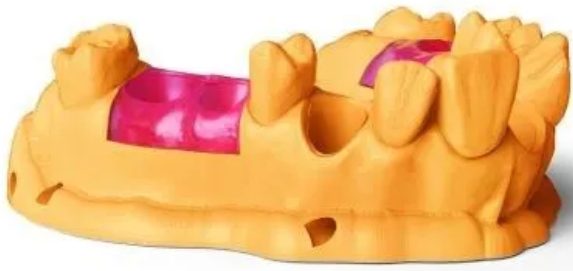
Demonstration model of the jaw with inserts from the NextDent Gingiva Mask
3. Harz Labs Dental Clear
Harz Labs Dental Clear is a transparent resin that is certified for medical use. Products made from this resin are durable and hard. The products also do not yellow.
This photopolymer is suitable for making surgical templates, demonstration models and even aligners.


AVAILABLE ON HARZ LABS
Specifications
- Print technology: DLP/LCD/LED
- UV wavelength: 405 nm
- Shore hardness: 90-92D
- Elongation at break: 4-6%
- Shrinkage: less than 0.5%
- Color palette: transparent
- Volume: 0.5kg, 1kg
Below are sample models made using the resin.


Demonstration model of the jaw

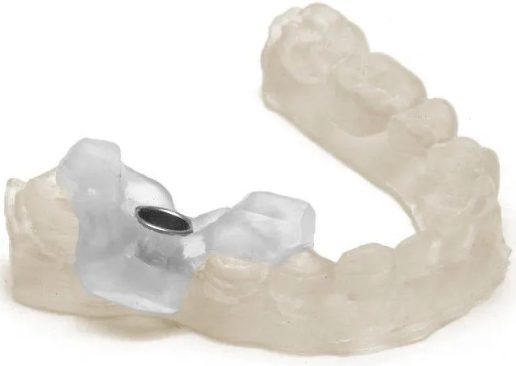
Jaw Piece Printed from Harz Labs Dental Clear
4. Harz Labs Dental Yellow Clear
This resin has properties similar to to Harz Labs Dental Clear. It is just as strong and solid. The only difference is that the color of the resin is not crystal clear, but yellow. The resin is certified for medical use.
Dental Yellow Clear is suitable for making aligners or demo models.


AVAILABLE ON HARZ LABS
Specifications
- Print technology: DLP/LCD/LED
- UV wavelength: 405 nm
- Shore hardness: 90-92D
- Elongation at break: 4-6%
- Shrinkage: less than 0.5%
- Color palette: transparent yellow
- Volume: 0.5kg, 1kg
Check the sample models made using the resin below.


Dental Yellow Clear gum patch

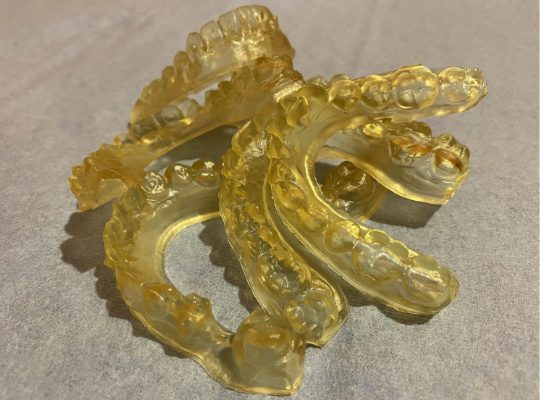
Jaw models


Dental Yellow Clear Demo Product
Burned Out Resins
In addition to specialized resins in dentistry, burnout or melted materials with low ash content are needed for direct casting.
Before casting, be sure to read the instructions from the manufacturer. Each resin has its own burnout cycle to obtain a good quality cast.
Below are the best burned out resins:
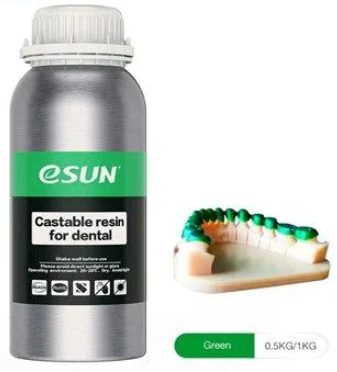
1. ESUN Castable for Dentistry
ESUN Castable is designed for direct casting in dentistry. The finished products are smooth and firm. When burned out, ash content is practically absent.
High precision allows ESUN Castable to be used for the manufacture of crowns, bridges and other products for subsequent casting.

AVAILABLE ON ESUN STORE
Specifications
- Print technology: DLP/LCD/LED
- UV wavelength: 405 nm
- Shore Hardness: 80D
- Elongation at break: 11-20%
- Flexural strength: 49-58 Mpa
- Impact strength according to Izod: 44 – 49 J / m
- Color palette: green
- Volume: 1 kg
Below are some sample models printed using the resin:


Crowns printed from ES


ESUN Castable Jaw


Example of a printed and cast model
2. Phrozen Wax-like Dental Green
Phrozen Wax-like Dental Green is a low shrinkage, zero ash wax like resin. Due to the low shrinkage, the finished products are very accurate. Also, the matte surface will help you to see even small imperfections.


AVAILABLE ON PHROZEN
Specifications
- Print technology: DLP/LCD/LED
- UV wavelength: 405 nm
- Color palette: green
- Volume: 0.5kg
Here is a model made using the resin.

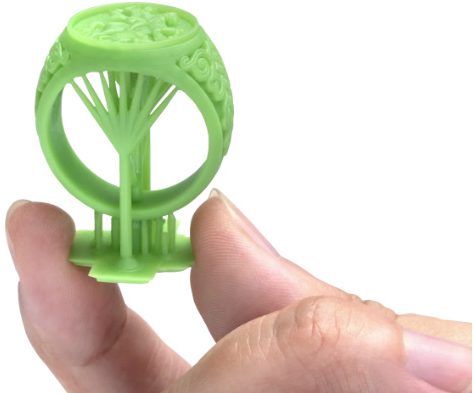
Ring made from Phrozen Wax-like Dental Green
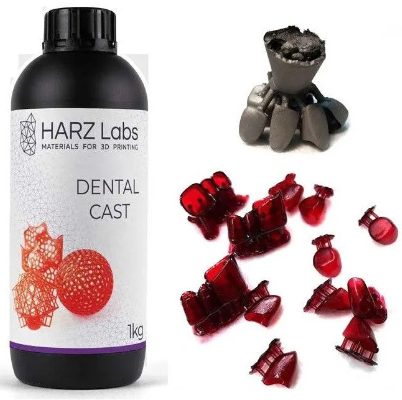
3. HARZ Labs Dental Cast Cherry
HARZ Labs Dental Cast Cherry was developed for direct casting of dental products. With the correct combustion cycle, it is possible to achieve almost zero ash content. The photopolymer is certified for medical use.
Dental Cast Cherry is suitable for casting crowns and bridges made of metal or ceramic.
The manufacturer recommends using phytomasses based on phosphates. This is because you can work with them at high temperatures, which is required for high-quality burning of the model.

AVAILABLE ON HARZ LABS
Specifications
- Print technology: DLP / LCD / LED
- UV wavelength: 405 nm
- Shore hardness: 40-50D
- Shrinkage: less than 1%
- Color palette: red
- Volume: 1 kg
Here are sample models made using the resin.


Crown Models Printed from Dental Cast Cherry


Cast crowns
4. NextDent Cast
This is an easy-to-burn resin with zero ash content. The resin is designed for the manufacture of burned out dental models.


AVAILABLE ON NEXTDENT
Specifications
- Print technology: DLP / LCD / LED
- UV wavelength: 405 nm
- Shore hardness: 80-90D:
- Color palette: red
- Volume: 1 kg
See some models made from the resin:

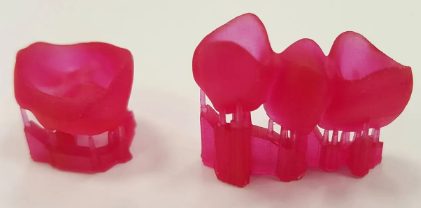
Crowns made from NextDent Cast

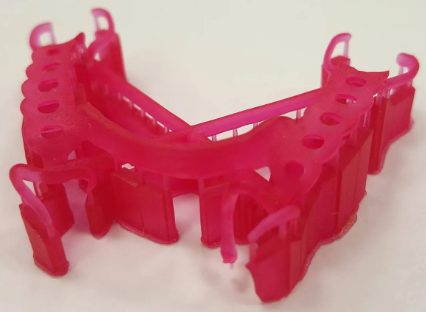
Demo model
5. DETAX Freeprint Cast UV
DETAX Freeprint cast UV is a precision resin designed for fast fabrication of dental products. Finished products can be used for direct casting. This resin burns out ashlessly, even with large casting volumes. It is recommended to use phosphate-based compounds for shaping.


AVAILABLE ON DETAX
Specifications
- Print technology: DLP / LCD / LED
- UV wavelength: 378 – 388 nm
- Color palette: red
- Volume: 1 kg
Check the sample models below:

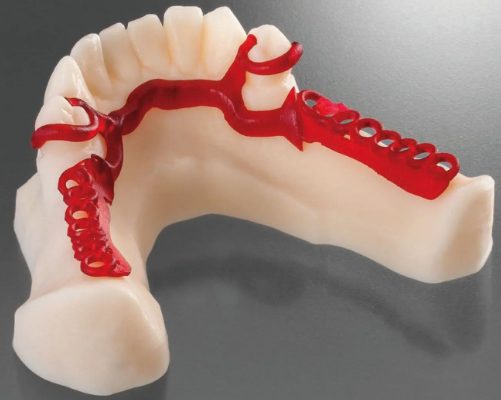
DETAX Freeprint cast UV overlay
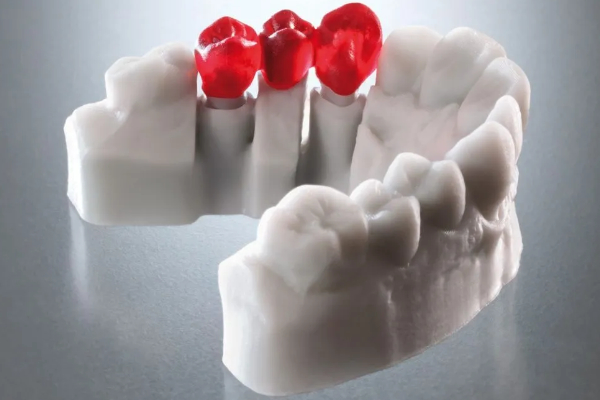
Crowns made from DETAX Freeprint cast UV
Burnt Resins
Apart from dentistry, 3D printers are firmly established in the jewelry industry. 3D printing allows you to create complex products much faster than classical methods (hand carving of wax, CNC machine, etc). Burnout resins have been created especially for jewelers.
Below are the best burnout resins for jewelry making.
1. ESUN Castable for Jewelers
ESUN Castable resin is specially developed for printing and subsequent casting of small models with high detail. Products from the resin have smooth and almost zero ash content. This makes it easy to get the right product in the metal.
The resin is suitable for printing jewelry – rings, pendants, earrings and other burnout models where precision and perfect surface quality are important.

AVAILABLE ON ESUN STORE
Specifications
- Print technology: DLP / LCD / LED
- UV wavelength: 395-405 nm
- Shore hardness: 60 D
- Color palette: yellow, green
- Volume: 1 kg
Here are some sample models:


Ring Printed From ESUN Castable

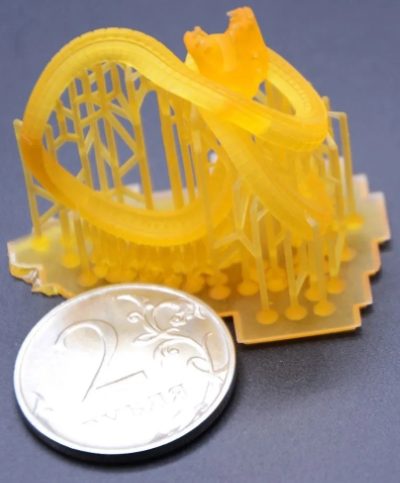
Ring from ESUN Castable
2. Phrozen Wax-like Castable Violet
Phrozen Wax-like Castable Violet is a wax-like polymer with low shrinkage and zero ash content. Products from the resin have a pleasant opaque surface on which will be seen the slightest imperfection.
Wax-like Castable is suitable for making any burnable models.


AVAILABLE ON PHROZEN
Specifications
- Print technology: DLP/LCD/LED
- UV wavelength: 405 nm
- Color palette: purple
- Volume: 0.5kg
Check the printed samples below.

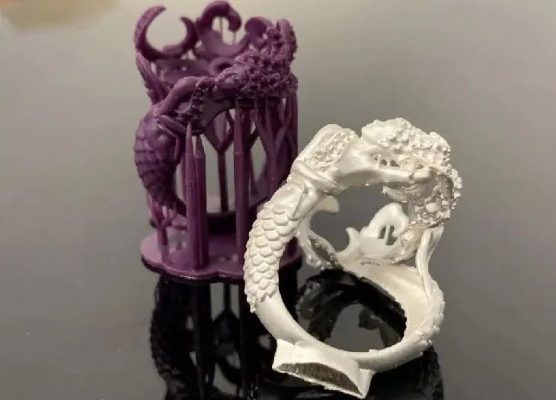
Ring Printed from Wax-like Castable and Finished Casting
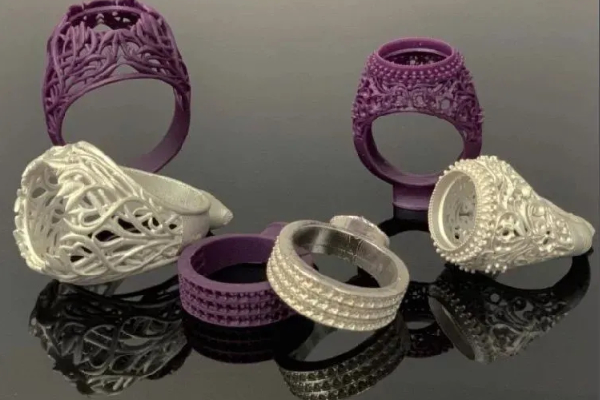
Openwork rings from Wax-like Castable and ready-made castings

Wax-like Castable Pendant and Finished Product
3. HARZ Labs Jewelry J-Cast
HARZ Labs Jewelry J-Cast resin is developed for the manufacture of burned-out models for subsequent metal casting. It’s characters of high precision, low shrinkage (less than 1%) and low ash content (less than 0.1%) allow even very small items to be printed without distortion.
This resin is suitable for jewelry printing. Due to its high thermoplasticity, the resin can be burned out over a wide temperature range. The result is a product with a smooth surface.
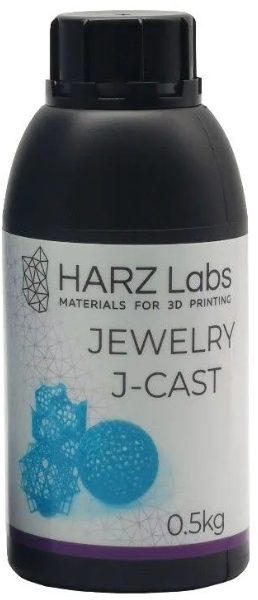

AVAILABLE ON HARZ LABS STORE
Specifications
- Print technology: DLP / LCD / LED
- UV wavelength: 405 nm
- Shrinkage: less than 1%
- Color palette: blue
- Volume: 1 kg
Here are some sample models:
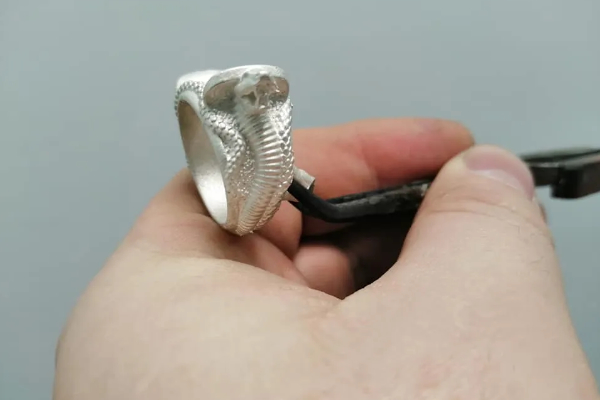
Ring cast with a model made from HARZ Labs Jewelry J-Cast
Conclusion
The various types of resins available make it possible to make various products from resin 3D printers. 3D printing not only helps to shorten the production chain in large enterprises, but has also become an indispensable tool for small home workshops.
When working with photopolymer resins, do not forget about safety precautions. In particular, remember the following:
- Wear gloves when working with resin. Uncured resin, even hypoallergenic, can irritate the skin.
- Stir the resin well before use. Colorants and other fillers can settle to the bottom of the can.
- Store photopolymer in an opaque container away from light.
- If you are pouring leftover resin from the 3D printer back into the jar, be sure to strain it.
- Print in a well-ventilated area.
- Check out the information about the resin on the manufacturer’s website. There may be important precautions to keep in mind. For example, some resins cannot be immersed in isopropyl alcohol for long periods of time.
The above are the best 3D printer resins for different uses.