


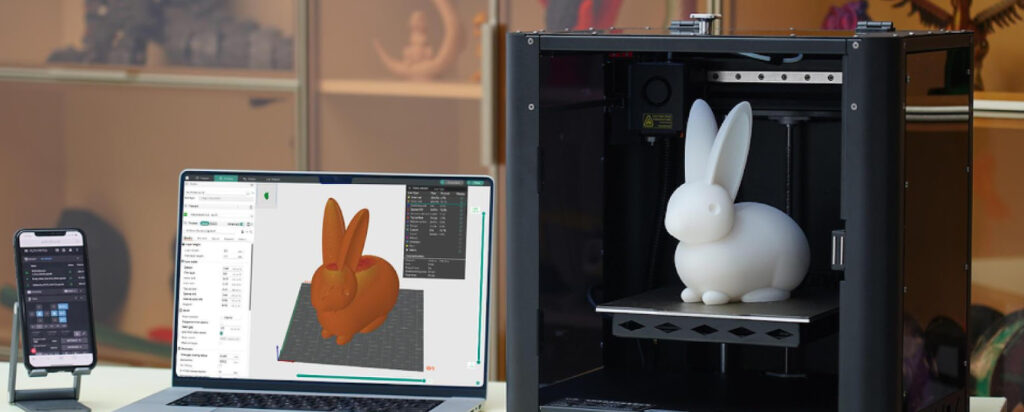
Today, we’re going to be reviewing the Kingroon KLP1 3D printer. We’ve had this unit in out Test Lab for a few weeks and are now confident using it. The KLP1 is a budget-friendly printer that has been making waves in the industry.
Below, we provide an objective overview of its key features and specifications.
Kingroon KLP1 Review


AVAILABLE ON KINGROON
Kingroon KLP1 Specifications
[su_table]
| Product Model | Kingroon KLP1 |
| Technology | FDM |
| Print Volume | 210*210*210mm |
| Machine Size | 400*420*420mm |
| Packaging Size | 420*490*470mm |
| Net Weight | 14kg |
| Firmware | Klipper |
| Print Via | Web/USB Flash Disk |
| Machine Power | 240W |
| Input Voltage | 110V-220V |
| Power Supply | 24V 12.5A 300W |
| Feeder System | Direct Extruder |
| Printing Accuracy | 0.05-0.3mm |
| Nozzle Max Temperature | ≤260 C |
| Heated Bed Max Temperature | ≤100 C |
| Max Movement Speed | ≤500mm/s |
| Acceleration | ≤20000mm/s² |
| Recommended Printing Speed | 200mm-350mm/S |
| File Format | STL/Obj/Gcode |
| Machine Leveling | Support |
| Material Break Detection | Yes |
| Power Loss Recovery | Yes |
| System Requirement | Win7-10/Mac/Linux |
| Slicing Software | Cura/Slice/Host… |
| Nozzle diameter | 0.4mm |
| Print Bed | Heat Bed With PEI Sheet |
| Languages | English, Spanish, German, French, Russian, Portuguese, Italian, Nederlands, Turkish, Japanese, Korean, Chinese |
[/su_table]
Printer Overview
The Kingroon KLP1 is a robust 3D printer that seamlessly combines affordability with impressive functionality. Let’s delve into the key specifications and features.
Klipper Software
The Kingroon KLP1 3D printer runs on Klipper software, which offers a solid foundation for reliable performance. The printer has linear rails on the X and Y axes, and linear rods on the Z-axis. The rails contribute to the stability and precision of the unit during printing.
Fully Assembled
The CoreXY 3D printer comes almost fully assembled, providing a user-friendly experience right out of the box. Inside the package are plexiglass panels, which you can fix to make the unit enclosed. The enclosure increases the versatility of the printer, allowing for both enclosed and open printing experiences. The enclosure will come in handy when working with high-temperature materials, like ABS, that benefit from an enclosed environment.
Print Volume
In terms of size, the KLP1 has a commendable print volume of 210 x 210 x 210 mms This spacious capacity opens up possibilities for a variety of creative projects.
The printer boasts a sturdy all-metal construction and weighs 14 kg. Its compact footprint measures 400 x 430 x 430 mm, making it a space-efficient addition to your workspace.


The Kingroon KLP1 has a Print Volume of 210 x 210 x 210 mm
Print Speed
In 3D printing, speed matters, and the KLP1 doesn’t disappoint. The KLP1 has an impressive printing speed of 350 mm/s. Therefore, it is suitable for projects that demand efficiency without compromising quality. The high acceleration of 10,000 mm/s² further emphasizes its capability to handle intricate designs swiftly.
Affordable
Finally, affordability is a key highlight of this unit. The price tag is under $400 (check price), which includes the touchscreen version. This makes the printer an attractive choice for those seeking a cost-effective yet feature-rich 3D printing solution.
Unboxing and Assembly
Now, let’s unbox the Kingroon KLP1 and get everything set up for the first print. The printer is shipped in good packaging to ensure it arrives to you intact.
Inside the box, everything is neatly organized in protective white foam. The printer comes almost fully assembled. You wont spend hours on assembly.
Apart from the printer, you will find various accessories in the box. These include sample PLA filaments, a touchscreen pen, power cables, tools, bolts, and a user manual. Overall, you get a comprehensive package that has everything you need for your 3D printing journey.
During unpacking, you’ll notice a set of plexiglass (acrylic) panels. These are designed to be fitted around the printer to provide an enclosed printing environment. The enclosure is particularly handy when experimenting with materials like ABS. The enclosure setup provides a clear view of the printing process.
Moving on to assembly, the process is user-friendly, thanks to a quick guide card provided. The initial steps involve removing securing bolts from the Y, X, and Z axes. The printer has linear rails on the X and Y axes for smooth and precise movements during printing. The Z-axis boasts a robust design with linear rods and bar bearings.
During the unboxing, we noticed some extra tools like wrenches, which do not match the nozzle. You won’t really need these wrenches during the assembly process. Follow the provided instruction manual to ensure a seamless setup.

The Instruction Manual
There is also a spare nozzle in the package. This is a good addition, saving us a couple of buck, in case we’d like to replace the nozzle down the line.
The assembly steps are outlined in a clear and concise manner in the manual. Whether you’re a novice or an experienced maker, the KLP1 is easy to assemble, ensuring that you spend more time creating and less time configuring.

KLP1 3D Printer Fully Assembled
Printer Features and Specifications
Let’s take a look at the key features and specifications of the KLP1 that contribute to its remarkable printing capabilities.
Touchscreen Interface
The Kingroon KLP1 3D printer features a 3.5-inch touchscreen user interface for managing your 3D printing efforts. This touchscreen simplifies the setup process and provides a convenient and visual way to navigate through the printer’s settings and features. The user-friendly design makes it easy to monitor and control prints through intuitive tapping and interactions.
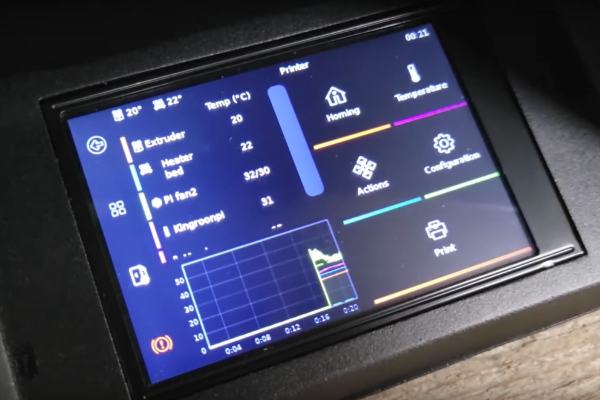
3.5″ Touchscreen
Extruder with 5:1 Gear Ratio
The Kingroon KLP1 features a remarkable 5:1 ratio extruder. The extruder features a fully metal construction that includes a 9500 rpm fan and 5015 bearings, a CHC hotend, intelligent microprocessors, and an upgraded extrusion system.
This improved gear mechanism has a dual extrusion structure that offers an impressive 5x extrusion ratio over conventional systems. The result is a significant increase in extrusion force and an improved cooling system. These two aspects contribute to more precise and efficient printing.
The all-metal extruder can process various filament types with precision. The gear ensures smooth and even filament feeding, thus contributing to overall print quality. This is a remarkable addition, especially for those who enjoy experimenting with different filament materials.
Built-in Accelerometer for Input Shaping
Another advanced feature is the built-in acceleration sensor that is specifically used for input shaping. This technology helps optimize the printer’s movements during printing. Input shaping minimizes vibrations and ensures smoother prints by dynamically adjusting the acceleration to the printer’s movement.
Maximum Printing Temperature of 300°C
The KLP1 has a maximum printing temperature of 300°C. This capability opens up the possibility of working with a variety of filaments, including those with higher temperature requirements. The all-metal hotend means that the printer can process various filaments with high temperature requirements.
Impressive Print Speed and Acceleration
This 3D printer has a remarkable print speed of 350 mm/s and an acceleration of 10,000 mm/s². These specifications not only lead to impressive numbers, but also to tangible benefits – faster print times and efficient production. During our experience, we were able to observe a noticeable reduction in print time without compromising print quality.
Budget-Friendly Pricing
With a modest price of $379, the KLP1 is an attractive option for anyone looking for an affordable 3D printer with plenty of features. The competitive price matches well with the printer’s capabilities and provides users with a cost-effective solution for their 3D printing needs.
Based on the printer’s features and specifications, it is clear that the Kingroon KLP1 is more than just an affordable option; it is a well-equipped device that meets the diverse needs of 3D printing enthusiasts.
Overall, the Kingroon KLP1 is a well-rounded 3D printer that offers a variety of features and capabilities at an affordable price. The printer is perfect for hobbyists and professionals who are looking for a reliable and efficient 3D printing solution.
Initial Setup and Calibration
Setting up the Kingroon KLP1 3D printer is child’s play. We guide you through the process with our firsthand experience. Here is a step-by-step guide:
Initial Setup
Language Setting
Firstly, select your preferred language using the small gear icon on the touchscreen interface. We found this step straightforward and appreciate the option to choose multiple languages.


Leveling the Bed
The next step is to level the bed. Remove the securing bolts on the Y, X, and Z axes as indicated in the user manual. This process is crucial for a leveled printing surface. Follow the simple instructions to achieve a stable and well-leveled bed.
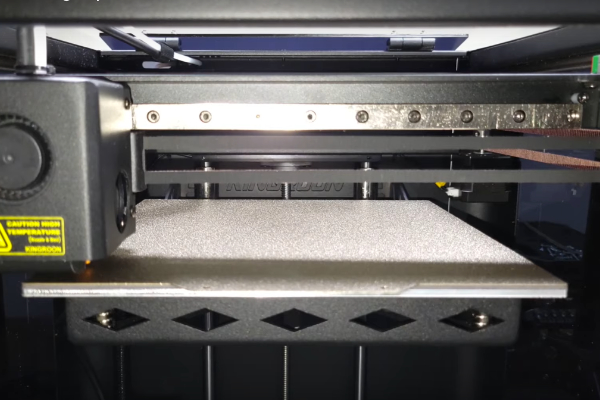
Leveling the bed
Input Shaper Calibration
The KLP1 introduces input shaping through the built-in accelerometer. This improves print quality by compensating for vibrations during movement. The printer guides you through a vibration measurement process for the X and Y axes. This might seem somewhat unusual, but rest assured, it is an important calibration step. Upon completion of this calibration, we noticed an improved print precision.
Calibrating the input shaper might cause some noise due to the robust stepper motors. This is a normal part of the calibration process. Rest assured, this noise is temporary and contributes to the precision performance of the KLP1.
Once you’ve completed these setup and calibration steps, your KLP1 is ready for high-quality 3D printing. Our experiences with this process were mostly positive, and we hope this guide assists you in embarking on your 3D printing journey with confidence. If you encounter any issues, detailed help is available in the user manual. Additionally, the KLP1 community is always ready to assist you.
Print Tests
Now comes the moment of truth – let’s delve into the world of print tests with the Kingroon KLP1. Below, we present a series of prints to evaluate the printer’s capabilities in various scenarios.
1. Calibration Cube
To start, we printed a quick calibration cube. This handy cube not only checks the printer’s accuracy but also serves as an excellent reference for checking dimensional accuracy. The KLP1 delivered a precise and accurate print.


2. Chemistry Cube
Next, we opted for a more intricate print – a 6-sided chemistry cube. This test aimed to evaluate the printer’s capability to handle complex geometries and intricate details. Impressively, the KLP1 executed this print flawlessly.
3. ABS Printing Inside the Enclosed Chamber
One of the standout features of the KLP1 is its fully enclosed chamber. This makes the machine suitable for printing with ABS filament. We tested this by printing a set of tweezers using ABS material. The enclosed chamber ensures a stable temperature and guarantees successful ABS printing without deformation.
4. Analysis of Print Quality, Adhesion, and Observed Anomalies
After analyzing our prints, we can affirm that the Kingroon KLP1 delivered commendable print quality across all our test prints. The layers adhered well, and dimensional accuracy was consistent. On some prints, we noticed a peculiar line. However, upon closer examination, we found that the line was more related to the slicer settings than an error from the printer itself.
Adhesion on the print bed was stable, thanks to the provided flexible sheet. Removing the prints was straightforward, and the spring surface proved to be a practical choice. In ABS printing, the enclosed chamber played a crucial role in avoiding deformations, resulting in a professionally finished product.
Overall, we were impressed by the versatility and reliability of the Kingroon KLP1 3D printer during our various test prints. Whether you’re a beginner dealing with simple prints or an experienced enthusiast delving into more intricate designs, the KLP1 proves to be a capable and user-friendly 3D printer. Our experience with the print tests left us impressed overall.
Observations and Recommendations
Our experiences with the KLP1 CoreXY 3D printer were generally positive. However, as with any technology, there are areas where improvements could enhance the user experience. Here are some significant observations and recommendations:
1. Filament Sensor Position
One feature that caught our attention is the positioning of the filament sensor. The sensor is precisely placed in the middle, which appears somewhat odd and potentially problematic. This central positioning on the spool might lead to issues, especially with brittle filament. For instance, if the filament tends to break or curl, the current sensor position could cause interruptions in the filament path.
In our tests with other printers, we’ve encountered situations where the sensor’s immediate proximity to the nozzle height could pose a risk, especially if the filament curls and could affect the leveling sensor. This could potentially be a concern, particularly for users who prioritize an uninterrupted and smooth printing process.
Kingroon might explore alternative positions for the filament sensor or consider adjustments to enhance its reliability. While the intent to place the filament sensor in the middle is clear, a slightly adjusted placement—perhaps a bit higher or lower—might benefit the part. This adjustment could potentially prevent filament interruptions and improve overall user-friendliness.
2. Lack of Clear Instructions for Connecting the Bowden Tube
During the unboxing and assembly phases, we encountered a minor issue with connecting the Bowden tube to the filament sensor. Clear guidance on the correct hose connection would be advantageous, especially for users less familiar with 3D printers. This would eliminate any guesswork and streamline the setup process.
3. Need for Additional Lighting Inside the Enclosure
While the enclosed chamber provides a stable printing environment, there’s a lack of sufficient interior lighting. This becomes noticeable, especially in prints with more challenging materials. We recommend considering the installation of LED lights to improve visibility and monitor prints.
4. Placement and Design of the Top Cover
While the design of the top cover is aesthetically pleasing, it impacts the extruder cable and the Bowden tube. The proximity of the cover forces the cable into a sharp bend, leading to friction and wear. We suggest revising the design to address this issue and enhance overall functionality.
Our recommendations aim to further enhance an already impressive 3D printer. The Kingroon KLP1, with its affordable price and functionality, has the potential to become even more user-friendly with these suggested improvements.
Conclusion
In conclusion to our test report on the Kingroon KLP1, we summarize the key points, highlight potential areas for improvement, and provide our overall recommendation.
What We Like
- Affordability and Functionality: The KLP1 stands out for its impressive combination of affordability and functionality. Users get a 3D printer capable of more than just creating figures at a budget-friendly price, making it suitable for various printing requirements.
- Specifications and Features: With a print volume of 210 mm in X, Y, and Z directions, a print speed of 350 mm/s, and an acceleration of 10,000 mm/s², the KLP1 boasts specifications geared towards both speed and precision. The use of linear rails and rods on different axes contributes to its overall stability.
- Enclosed Chamber: The fully enclosed chamber enables a controlled temperature environment, making it suitable for experimenting with various filaments, including ABS.
- Touchscreen Interface and Input Shaping: The integration of a touchscreen interface and features like Input Shaping enhances the user experience and provides flexibility in controlling the printer.
- Solid Construction and Sleek Design: The all-metal construction of the printer, from the frame to the extruder head, gantry, and spool holder, gives the printer a robust and elegant aesthetic.
- User-Friendly Assembly and Calibration: The nearly fully assembled device simplifies unboxing, and the primary assembly steps are user-friendly. Calibration, including Z-calibration, bed leveling, and input shaping calibration, is easy to perform.
- Powerful Interface: The 3.5-inch touchscreen, though resistive, offers a detailed Clipper user interface. The Wi-Fi connectivity adds convenience for remote control and monitoring.
Areas for Improvement
Although our experiences were positive, we’ve identified areas where the KLP1 could be further improved:
- Filament Sensor Placement: Adjusting the placement of the filament sensor could simplify filament changes for users.
- Instructions for Bowden Tube Connection: Clearer guidance on connecting the Bowden tube to the filament sensor would enhance the setup process.
- Internal Lighting: Additional integrated LED lighting inside the enclosure would improve visibility during printing.
- Profile Challenges: The printer’s weakness lies in the lack of predefined profiles, resulting in inconsistent print results. A more comprehensive set of profiles would significantly enhance user-friendliness.
Overall Recommendation
For potential users looking to explore the world of 3D printing, the Kingroon KLP1 3D printer is an enticing option. Its affordable price combined with robust features makes it an excellent choice for beginners and enthusiasts alike. The identified areas for improvement are minor and do not overshadow the printer’s positive aspects.
In summary, the KLP1 has the potential to be a reliable companion on your 3D printing journey. With a keen eye on user feedback and potential updates, this printer promises an even smoother and more enjoyable printing experience.
BUY AT KINGROON