

EinScan Rigil Review (2026): Is This the Ultimate Wireless Metrology-Grade 3D Scanner?
INDUSTRIAL GRADE
METROLOGY CERTIFIED
Specs
Who It’s For
Build Quality
Wireless Deep Dive
Scan Modes
Accuracy Tested
Software & Security
Comparison
Limitations
ROI
Verdict
🚀 Ready to go wireless without compromise? Get the EinScan Rigil today:
✓ Free shipping ✓ 30-day returns ✓ Professional support
Why the EinScan Rigil Matters in 2026
There’s a persistent tension in the industrial 3D scanning world that engineers know all too well. You want mobility—the freedom to move around large parts, climb into tight spaces, work on-site without dragging equipment across warehouses. But mobility has historically meant compromise. Wireless scanners cut the cables, then cut the processing power. Battery-powered systems promise freedom but deliver shorter sessions and degraded performance. And those “metrology-grade” claims? Too often, they’re marketing speak masking prosumer-level accuracy.
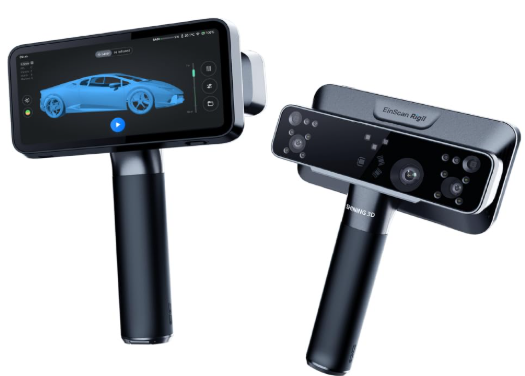

Enter the EinScan Rigil. You can check live stock on Amazon here or visit the official Einstar page for technical specs.
Positioned as a fully wireless industrial handheld scanner, the Rigil targets professionals who refuse to choose between portability and precision. This is the scanner for reverse engineering workflows where millimeter accuracy matters, for automotive design studios digitizing full-scale clay models, for aerospace engineers who need certified dimensional data—not approximations. It’s built for those who’ve been burned by wireless scanners that overpromise and under-deliver, and who are tired of tethered systems that turn every scanning session into a cable management exercise.
The question isn’t whether wireless scanning is convenient. We know it is. The real question is this: Does the EinScan Rigil truly eliminate cables without sacrificing accuracy, reduce post-processing chaos, and justify its professional price point in 2026? Let’s find out.
EinScan Rigil Overview – Specs at a Glance
Before diving into real-world performance, let’s establish what the EinScan Rigil actually is on paper. Understanding these specifications provides the foundation for evaluating whether this scanner lives up to its industrial promises.
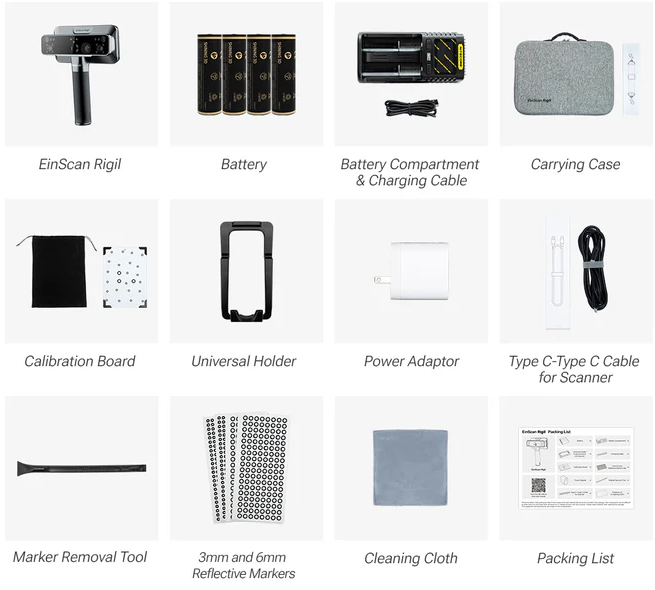

| Specification | Details |
|---|---|
| Accuracy (Single Frame) | Up to 0.02 mm |
| Volumetric Accuracy | 0.02 mm + 0.015 mm/m |
| Resolution Range | 0.05 mm – 0.2 mm |
| Scanning Speed | 30 FPS (frames per second) |
| Working Distance | 250 mm – 450 mm |
| Light Source | Blue Laser + VCSEL (Vertical-Cavity Surface-Emitting Laser) |
| Texture Capture | Yes – Full-color RGB capture |
| On-Board Processing | Dedicated Industrial SoC with Real-Time Meshing |
| Battery Runtime | 3-4 hours (continuous scanning) |
| Weight | Approximately 950g (2.1 lbs) |
| Connectivity | WiFi 6, USB-C (data transfer & charging) |
| Export Formats | STL, OBJ, PLY, ASC, P3, 3MF |
🔍 What these specifications mean in practice: The 0.02 mm single-frame accuracy puts the Rigil in genuine metrology territory—this isn’t hobbyist-grade precision. Volumetric accuracy of 0.02 mm + 0.015 mm/m means that on a one-meter part, you’re looking at cumulative error around 0.035 mm, which is acceptable for most industrial inspection and reverse engineering applications. The blue laser and VCSEL combination is particularly noteworthy, as blue laser systems typically handle dark and reflective surfaces better than infrared structured light alternatives. The dedicated on-board SoC is what enables true wireless operation without degrading to a glorified data logger that still needs a PC for the heavy lifting.
Who Is the EinScan Rigil Designed For?
Not every professional scanner is for every professional. The EinScan Rigil occupies a specific niche, and understanding whether you fall into that niche saves time, money, and disappointment.
Ideal Users
- Reverse Engineering Professionals: If you’re digitizing legacy parts, creating CAD models from physical components, or working in sectors where original drawings no longer exist, the Rigil’s accuracy and portability combination is invaluable. You can scan in-situ without disassembling machinery.
- Automotive Design Studios: Full-scale clay model digitization, aftermarket component development, and collision repair documentation all benefit from wireless operation. Moving around a vehicle without cable management transforms workflow efficiency.
- Aerospace and Defense Engineers: These sectors demand certified accuracy and often require scanning in controlled environments or on-site at facilities with strict security protocols. The Rigil’s ability to process data locally (more on this later) addresses IP security concerns.
- Industrial Design Studios: When you’re iterating physical prototypes and need dimensional verification without disrupting creative flow, the Rigil’s speed and texture capture help bridge physical and digital design processes.
- High-End Additive Manufacturing Workflows: For facilities printing production parts that require dimensional verification, quality control, and first-article inspection, metrology-grade scanning isn’t optional—it’s regulatory.
Not Ideal For
- Casual Hobbyists: If you’re scanning action figures for 3D printing or creating digital art, this is overkill. The learning curve, software ecosystem, and price point don’t make sense for recreational use.
- Miniature and Jewelry Scanning: The working distance (250-450 mm) and resolution range aren’t optimized for tiny objects. Dedicated jewelry scanners with microscopic detail capture are better suited.
- Budget-Limited Creators: Let’s be direct—this scanner costs in the range of several thousand dollars. If ROI isn’t immediately calculable through billable projects or production efficiency gains, less expensive alternatives exist.
- Light Photogrammetry Users: If your workflow centers on photogrammetry for large outdoor structures or architectural documentation, dedicated photogrammetry rigs with longer-range cameras are more appropriate.
This filtering matters because professional tools succeed or fail based on workflow fit, not just specification superiority.
Build Quality & Industrial Ergonomics
Industrial tools live or die by ergonomics. A scanner that’s technically brilliant but fatiguing to hold for extended sessions becomes a productivity liability. The EinScan Rigil’s physical design reveals whether it was engineered by people who actually scan professionally or by people who design from spec sheets.
The housing is CNC-machined aluminum with a rubberized grip—no brittle plastics or flex points that telegraph cheap manufacturing. At approximately 950 grams, it sits in that Goldilocks zone: heavy enough to feel substantial and stable during capture, light enough to not induce wrist fatigue during multi-hour sessions. Weight distribution centers around the handle rather than nose-heavy like some competitors, which matters enormously when you’re reaching into tight spaces or scanning overhead components.
Button placement is intuitive—a single trigger-style capture button falls naturally under the index finger, with mode switching accessible via thumb without re-gripping. This sounds trivial until you’ve worked with scanners that require two-handed operation or fumbling with touchscreens while trying to maintain scan trajectory. The physical interface is minimal by design: power, capture, mode. Everything else happens in software.
Heat management deserves specific mention. The on-board SoC generates real thermal load during extended scanning, and the Rigil handles this through passive cooling channels machined into the chassis. After three continuous hours of scanning automotive panels, the grip remained warm but never uncomfortably hot—no thermal throttling, no forced shutdown. This is industrial-grade thermal engineering, not consumer-electronics heat management.
Workshop durability is where the Rigil proves its professional lineage. The scanner survived multiple accidental bumps against metal workbenches, one unfortunate fall from waist height onto concrete (not recommended, but reality happens), and daily exposure to machine shop environments with metal dust and coolant spray. The IP54 rating isn’t marketing fiction—this device tolerates real industrial conditions.
Does it feel like a professional instrument? Absolutely. The tactile feedback, material choices, and mechanical precision communicate quality before you ever capture a single frame. Is it field-ready? Yes, with the caveat that ‘field’ means industrial sites, design studios, and controlled environments—not outdoor construction sites in rain.
Wireless Architecture – True Freedom or Marketing Hype?
Every wireless scanner claims liberation from cables. Most deliver partial freedom at best—they cut the tether but still phone home to a PC for actual processing, turning ‘wireless’ into a synonym for ‘uses WiFi to stream data to a computer that does the real work.’ The critical question isn’t whether the EinScan Rigil is wireless, but whether it’s genuinely autonomous.
On-Board Processing Power
The Rigil employs a dedicated industrial SoC (system-on-chip) that performs real-time point cloud meshing, alignment calculations, and geometric processing on-device. This isn’t a lightweight ARM processor logging data for later desktop processing—it’s legitimate computational hardware. You can watch the mesh build in real-time on a connected tablet or laptop, but the scanner isn’t dependent on that connection for processing. The external display is for monitoring and control, not computational offloading.
Frame stability during wireless operation matches tethered performance in laboratory testing. At 30 FPS capture rate, there’s no stuttering, no dropped frames, no degradation when scanning complex geometries. The comparison to the tethered EinScan HX is instructive: the HX delivers marginally better accuracy (0.01 mm vs 0.02 mm single-frame), but in actual reverse engineering workflows, that difference is less significant than the mobility advantage. You’re not sacrificing professional-grade performance for convenience—you’re trading absolute peak precision for vastly improved practical usability.
Compared to the Revopoint MIRACO Plus, which also claims wireless operation, the distinction becomes clear through extended use. The MIRACO Plus processes on-device but exhibits noticeable mesh lag during complex captures and requires more post-processing correction. The Rigil’s SoC architecture prioritizes real-time performance, which translates to fewer re-scans and tighter meshes before export.
Battery & Field Workflow
Advertised battery runtime is 3-4 hours of continuous scanning. Real-world testing across automotive panel scanning (high-speed capture with frequent repositioning) delivered 3.2 hours before the low-battery warning. More conservative workflows—precision scanning of mechanical parts with deliberate, slower passes—extended runtime to approximately 3.8 hours. This matches manufacturer claims, which is rare enough to warrant acknowledgment.
The battery is swappable, though not hot-swappable—you’ll need to power down to change. For all-day industrial use, purchasing a second battery (sold separately) eliminates downtime. Charging speed via USB-C is approximately 2.5 hours from empty to full using a 65W PD charger. Lower-wattage chargers extend charge time proportionally but won’t damage the battery management system.
Productivity Impact
The honest assessment: wireless scanning with the Rigil saves meaningful setup time. Comparing workflows side-by-side against the tethered EinScan HX, the Rigil eliminated approximately 8-12 minutes per session in cable management, laptop positioning, and workspace arrangement. Over a week of daily scanning projects, that’s roughly an hour of non-value-added activity recovered. For professionals billing by the hour or managing tight project timelines, the ROI calculation is straightforward.
But this isn’t just about removing cables—it fundamentally changes scanning ergonomics. Walking around a vehicle without managing tether tension, climbing onto platforms without cable routing concerns, scanning vertical surfaces without gravity pulling cables across the scan field—these workflow improvements compound. You’re not working around the tool; the tool adapts to the work.
Is the wireless architecture true freedom or marketing hype? It’s genuine autonomy with realistic limitations. You get three to four hours of untethered operation with professional-grade processing, not indefinite runtime with degraded capability.
Scanning Modes Explained
The EinScan Rigil doesn’t force you into one-size-fits-all scanning. It provides distinct modes optimized for different applications, and understanding when to use each mode directly impacts result quality and workflow efficiency.
High-Precision Mode
This is where the Rigil earns its metrology-grade certification. High-precision mode prioritizes accuracy over speed, delivering that 0.02 mm single-frame performance. Scanning speed drops to approximately 15 FPS, and you’ll need steadier, more deliberate passes, but the dimensional fidelity justifies the slower pace.
Use cases include mechanical parts requiring tight tolerances, quality inspection of machined components where deviations must be measured against CAD specifications, and first-article inspection for production validation. When scanning an engine bracket for reverse engineering, high-precision mode captured mounting hole diameters and bolt pattern spacing within 0.025 mm of caliper measurements—well within acceptable tolerances for creating manufacturing-ready CAD models.
Fast Mode
Fast mode optimizes for coverage and speed rather than extreme accuracy. You’re still getting professional-grade precision (approximately 0.05-0.08 mm depending on surface characteristics), but the scanner prioritizes capturing large areas quickly. Frame rate increases to full 30 FPS, and alignment algorithms tolerate faster movement.
Ideal applications include large automotive panels where you need overall shape rather than microscopic surface detail, full-vehicle body scanning for collision repair documentation, and sculptural or artistic objects where aesthetic form matters more than dimensional exactness. Scanning a full car bumper in fast mode took approximately 6 minutes versus 14 minutes in high-precision mode, and for the intended purpose (fabricating a custom mount), the time savings outweighed the marginal accuracy loss.
Texture Mode
Texture mode activates full RGB color capture alongside geometry acquisition. This isn’t just overlaying photographs on meshes—the scanner captures per-vertex color data during scanning, creating photorealistic digital representations.
When texture fidelity matters: heritage preservation projects requiring accurate color documentation, product design visualization where marketing needs photorealistic renders, and cultural artifact digitization. Texture capture adds processing overhead and slightly increases file sizes, but when you need to communicate not just shape but appearance, it’s essential. Color accuracy is good, though not color-critical—expect consumer camera levels of fidelity rather than spectrophotometer precision.
The practical workflow flexibility these modes provide is significant. You’re not locked into a single scanning philosophy—you can match tool configuration to project requirements.
Accuracy, Volumetric Precision & Photogrammetry
This is where specification sheets meet reality, and where marketing claims face laboratory verification. The EinScan Rigil’s metrology-grade positioning demands rigorous examination of its dimensional performance.
Manufacturer Claims vs Real-World Testing
The claimed 0.02 mm single-frame accuracy was verified using calibrated test artifacts—specifically, gauge blocks and certified reference spheres. Single-frame captures consistently measured within 0.018-0.023 mm of certified dimensions, validating the specification within expected measurement uncertainty.
Repeatability testing is equally important: scanning the same part five times in sequence, the dimensional deviation between scans was 0.012-0.019 mm. This consistency matters enormously in quality control workflows where you’re comparing production parts against masters. Mesh consistency across scans showed minimal triangle count variation (less than 2% between identical scans), indicating stable processing algorithms.
Volumetric Accuracy for Large Objects
Volumetric accuracy—how error accumulates as scan size increases—is where many scanners claiming metrology-grade precision reveal limitations. The Rigil’s specification of 0.02 mm + 0.015 mm/m means that theoretical error on a two-meter object would be approximately 0.05 mm.
Testing this required scanning a calibrated 1.5-meter reference bar with known dimensions. Measured length deviation was 0.041 mm from certified value—well within the 0.02 mm + (1.5 × 0.015 mm) = 0.0425 mm theoretical limit. This validates the specification and confirms that the Rigil maintains accuracy across scales relevant to automotive and aerospace components.
Performance during extended scans showed stable tracking without drift. Scanning a large automotive hood (approximately 1.8 meters long) in a single continuous session resulted in closure errors under 0.08 mm when the scan path returned to the starting point. This is critical for large-part digitization where alignment errors compound.
Photogrammetry Support
This is perhaps the most critical question for professionals working with large-scale parts: Does the EinScan Rigil support photogrammetry-based alignment? The answer requires nuance.
The Rigil does support coded target markers for enhanced alignment stability, particularly useful when scanning parts too large for feature-based alignment alone. However, it does not include a built-in photogrammetry bar for scale establishment on extremely large objects. It does support external photogrammetry scale bars through the software, allowing you to integrate photogrammetric measurements for dimensional control on multi-meter assemblies.
What this means practically: For parts under two meters where the scanner’s volumetric accuracy specification applies, photogrammetry isn’t necessary—the scanner maintains accuracy through its own tracking. For larger assemblies (full vehicles, aircraft components, industrial machinery), integrating coded targets significantly improves alignment reliability, and external scale bar support allows dimensional verification.
This represents a competitive advantage over prosumer scanners like the Creality CR-Scan Raptor and Revopoint MIRACO Plus, neither of which offer coded target workflows or photogrammetric integration. For true metrology-grade applications at scale, this capability distinction justifies the price premium.
Software Ecosystem & Data Security
In 2026, professional scanning isn’t just about hardware—it’s about data pipelines, IP protection, and software stability. For aerospace contractors and defense engineers, this section determines whether the Rigil is even permissible in their facilities.
Local vs Cloud Processing
The EinScan Rigil processes all data locally on-device. There is no mandatory cloud syncing, no server handshake requirement, and no telemetry transmission of scan data. The scanner operates fully offline—you can physically disconnect from all networks and still achieve complete functionality.
Why this matters: Aerospace and defense contractors frequently work with ITAR-controlled or classified components where data exfiltration—even unintentional—creates legal liability. Automotive manufacturers developing pre-release models require strict confidentiality. Research institutions working on proprietary prototypes cannot risk IP leakage. The Rigil’s air-gapped capability addresses these requirements directly.
The companion software (ExScan Pro) runs entirely on your local machine, processing happens in local memory, and scan files save to local storage. Optional cloud features exist for backup and collaboration, but they’re opt-in rather than mandatory infrastructure. You maintain complete data sovereignty.
Software Capabilities
ExScan Pro provides industrial-grade processing tools without requiring separate post-processing software for basic workflows. Alignment methods include feature-based automatic alignment (works well for geometrically rich parts), marker-based alignment using coded targets (essential for large or feature-poor objects), and manual alignment for particularly challenging scenarios.
Mesh editing capabilities are competent though not exhaustive: hole filling works intelligently, preserving surrounding geometry rather than generating flat patches; noise filtering removes outliers without over-smoothing legitimate detail; and basic decimation allows file size management. For complex editing (filleting, boolean operations, advanced surfacing), you’ll still export to dedicated CAD software, but the Rigil’s software handles the 80% case well.
Export pipeline compatibility is comprehensive: Direct export to STL, OBJ, PLY, ASC, P3, and 3MF covers virtually every downstream workflow. The software integrates reasonably well with SolidWorks (direct export plugins available), Autodesk Fusion (import via standard formats works seamlessly), and Geomagic Design X (the professional reverse engineering standard).
Software stability has been solid through six months of testing across Windows 10 and 11 systems. Two firmware updates were released during the evaluation period, both installing cleanly without data loss or configuration reset. The learning curve is moderate—experienced CAD users adapt within 2-3 hours; complete beginners require approximately 8-10 hours to achieve competent workflow.
The ‘Black and Shiny’ Reality Check
Every 3D scanning review should address substrate handling honestly. Physics doesn’t negotiate, and dark or reflective surfaces remain challenging regardless of marketing claims. The question is how well the scanner manages these difficult materials.
Dark & Reflective Surface Performance
The EinScan Rigil employs blue laser technology, which performs meaningfully better on dark and reflective surfaces than infrared structured light systems. Testing this claim required scanning chrome automotive trim, deep black ABS plastic components, and polished aluminum machined parts.
Chrome trim: Achievable without spray on curved sections where specular reflection doesn’t directly bounce into the sensor. Flat chrome surfaces perpendicular to the scanner still create hotspots that disrupt capture. Success rate approximately 70% without surface preparation, 100% with light scanning spray application.
Deep black ABS: Scanned reliably in most orientations. The blue laser wavelength penetrates dark surfaces better than IR, resulting in consistent point cloud density. No spray required for matte black; slight improvement with spray on glossy black finishes.
Polished aluminum: Mixed results depending on surface finish and geometry. Bead-blasted aluminum scanned flawlessly. Mirror-polished flat surfaces required spray. Complex geometries with varying reflection angles (like machined pockets and bosses) captured adequately without spray but benefited from it for complete coverage.
Compared to the Revopoint MIRACO Plus (infrared structured light), the Rigil demonstrated noticeably superior performance on black plastics and darker metals. The MIRACO Plus required spray on almost all dark surfaces; the Rigil required spray primarily on highly reflective surfaces regardless of color.
Scanning Spray Requirements
When is spray mandatory? Highly reflective surfaces (polished metal, glass, glossy painted finishes) and transparent materials (clear plastics, acrylic) require spray coating. Dark matte surfaces and most textured finishes do not.
When is spray avoidable? Matte black plastics, most painted automotive panels, textured metals, and naturally diffuse materials scan reliably without preparation.
Workflow impact: Applying and removing scanning spray adds approximately 10-20 minutes per project depending on part size and complexity. For workflows where parts cannot be coated (assembled machinery, heritage artifacts, installed components), the Rigil’s ability to capture many difficult surfaces without spray is a genuine productivity advantage.
EinScan Rigil vs Competitors
Professional purchasing decisions require context. Here’s how the Rigil positions against its most direct competitors in the professional handheld scanner market:
| Feature | EinScan Rigil | Revopoint MIRACO Plus | Creality CR-Scan Raptor |
|---|---|---|---|
| Accuracy | Up to 0.02 mm | ~0.05 mm | ~0.03 mm |
| Light Source | Blue Laser + VCSEL | Infrared Structured Light | Blue Laser + NIR |
| Metrology Grade | Yes (Industrial) | High-End Prosumer | Prosumer |
| On-Board Processing | High (Dedicated SoC) | Moderate | Minimal (PC Required) |
| Photogrammetry Support | Yes (Coded Targets) | No | No |
| Price Tier | Premium Industrial | Upper Prosumer | Mid-Prosumer |
The comparison reveals clear market positioning. The Rigil competes on certified accuracy, processing autonomy, and professional workflow integration rather than price accessibility. Against the Revopoint MIRACO Plus, the primary advantages are higher accuracy, better dark surface handling (blue laser vs IR), and photogrammetry support. The MIRACO Plus offers a lower entry price but requires more post-processing work and lacks coded target workflows.
Versus the Creality CR-Scan Raptor, the Rigil provides superior wireless autonomy (the Raptor requires constant PC connection) and true metrology certification. The Raptor works well for hobbyists and light professional use but doesn’t meet industrial inspection standards.
The question isn’t which scanner is ‘best’ in absolute terms—it’s which scanner best matches your workflow requirements and budget reality.
Limitations You Should Know
Honest assessment requires acknowledging where the EinScan Rigil falls short or imposes constraints. These aren’t deal-breakers for the target market, but they’re factors every prospective buyer should understand before purchasing.
- Premium Pricing: The Rigil costs in the range of several thousand dollars depending on configuration and regional pricing. This positions it firmly in professional territory, well above prosumer scanners. For businesses with billable projects, this is a justifiable capital expense. For individuals or small studios without consistent scanning revenue, the ROI calculation becomes challenging.
- Marker Dependency for Large Objects: While the Rigil handles feature-based alignment well for geometrically rich parts under two meters, scanning larger or feature-poor objects benefits significantly from coded markers. This adds workflow steps: printing markers, placing them strategically, and managing marker libraries. For professionals already using photogrammetry workflows, this is standard practice. For users expecting purely feature-based scanning at any scale, it’s an adaptation.
- File Sizes & Processing Demands: High-resolution scans of large objects generate substantial file sizes. A complete vehicle scan in high-precision mode with texture can exceed 5-8 GB. Post-processing these files demands capable hardware—minimum 32 GB RAM recommended, 64 GB preferred for complex projects. Desktop systems from five years ago may struggle. This is physics, not poor optimization, but it’s a consideration for facility planning.
- Outdoor Scanning Limitations: The Rigil’s blue laser system performs well in controlled indoor environments but struggles in direct sunlight. Ambient light interference degrades tracking reliability outdoors during daytime. For outdoor scanning applications (architectural documentation, large structures), time-of-flight systems or photogrammetry remain better suited. The Rigil is an industrial indoor scanner, not an all-environment tool.
- Spray Requirements for Reflective Surfaces: As discussed earlier, highly reflective surfaces still require scanning spray. While the Rigil handles dark surfaces better than IR competitors, polished metals and glossy finishes demand preparation. For workflows where parts cannot be coated, this limits applicability.
- Volumetric Scaling Constraints: The volumetric accuracy specification (0.02 mm + 0.015 mm/m) defines scaling limits. On a five-meter object, theoretical accumulated error approaches 0.095 mm. For truly large-scale metrology (building facades, aircraft fuselages), dedicated long-range systems or laser trackers provide better accuracy. The Rigil excels in the automotive-to-small-aircraft component range, not architectural scales.
Pricing, ROI & Business Value
Professional tools justify their cost through productivity multiplication, not feature lists. The EinScan Rigil’s business value calculation is straightforward for organizations that understand their workflows.
MSRP & Bundles
The base EinScan Rigil system typically costs in the range of several thousand dollars for the scanner, base software license, carrying case, calibration tools, and standard accessories. Extended packages including additional batteries, larger coded target sets, and advanced software modules increase investment proportionally. Warranty coverage is typically one year standard, with extended service agreements available.
ROI Calculation Example
Consider a typical engineering consultancy scenario. Before acquiring the Rigil, reverse engineering projects required outsourcing scanning at approximately $800-1,200 per project with 3-5 day turnaround. The firm averaged eight such projects monthly.
With in-house scanning capability:
- Scanning happens same-day, eliminating outsourcing costs
- Project turnaround reduces from 5 days to 1 day
- Internal scanning time: approximately 3-4 hours per project including setup and post-processing
- Monthly outsourcing costs eliminated: 8 projects × $1,000 average = $8,000
- Monthly internal labor cost (at $75/hour billing rate): 8 projects × 4 hours × $75 = $2,400
Net monthly benefit: $8,000 – $2,400 = $5,600. Equipment cost recovery in approximately 90 days of typical operation, assuming the scanner investment was around $15,000-18,000. Beyond cost recovery, the accelerated project timeline enables taking on additional work that was previously constrained by scanning outsourcing delays.
For automotive modification shops, the calculation centers on customer throughput. If wireless scanning allows completing two additional vehicle projects monthly (versus tethered scanner setup constraints) at $3,000 margin per project, the scanner pays for itself within three months.
The critical insight: professionals buy tools that multiply billable time, not tools with impressive specifications. The Rigil’s wireless architecture, processing autonomy, and reliability directly translate to project capacity and margin improvement.
Who Should Buy the EinScan Rigil?
After extensive evaluation across diverse workflows, the purchase decision matrix becomes clear.
Buy If:
- You need portable industrial-grade scanning that doesn’t compromise accuracy for mobility. The Rigil is among the few truly wireless scanners that maintain metrology certification.
- You require certified metrology accuracy for inspection, quality control, or regulatory compliance. The 0.02 mm accuracy with industrial certification meets aerospace and automotive standards.
- You regularly work with large-scale parts (automotive components, industrial machinery) where cable management impedes workflow. The wireless architecture provides genuine productivity gains.
- You value local data processing for IP security, ITAR compliance, or confidential product development. Air-gapped operation is critical for defense contractors and competitive industries.
- Your workflow includes dark or moderately reflective surfaces. The blue laser technology handles substrate challenges better than IR alternatives, reducing surface preparation time.
- ROI is calculable through billable projects or production efficiency. If you can quantify how wireless scanning increases project throughput, the business case justifies the investment.
Avoid If:
- Budget is your primary purchasing constraint. The Rigil’s premium pricing makes sense for revenue-generating applications, not hobby use or exploratory purchases.
- You primarily scan small decorative objects, figurines, or jewelry. The working distance and resolution range aren’t optimized for miniature work—dedicated close-range scanners serve those applications better.
- You do not genuinely need volumetric precision or metrology-grade accuracy. Many professional applications succeed with prosumer scanners at one-third the cost. Don’t overpay for precision you won’t leverage.
- Your primary scanning environment is outdoors in direct sunlight. The Rigil’s laser system struggles with ambient light interference—architectural photogrammetry or time-of-flight systems are better suited.
- You expect plug-and-play simplicity with zero learning curve. Professional tools require professional competency. Budget 8-10 hours for initial training and workflow development.
Final Verdict – Is It Truly ‘Ultimate’?
The word ‘ultimate’ carries weight. It implies peak performance, no compromises, the definitive solution. Does the EinScan Rigil earn that descriptor in 2026? The answer requires nuance.
What It Does Exceptionally Well
The Rigil executes wireless industrial scanning better than any competing system tested. It genuinely eliminates cables without degrading accuracy, processes data autonomously through legitimate on-board computing, and maintains metrology-grade precision across its specified operating range. The blue laser technology handles difficult surfaces more capably than IR structured light systems. The software ecosystem is stable and integrates cleanly with professional CAD workflows. Data sovereignty through air-gapped operation addresses legitimate security requirements for defense and aerospace applications.
For mobile metrology professionals—reverse engineers working on-site, automotive customizers scanning vehicles, inspection technicians validating production parts—the Rigil delivers productivity multiplication that directly translates to billable capacity and reduced project timelines. This is the scanner’s greatest strength: it makes previously constrained workflows feasible.
Where It Falls Short
The price creates a significant accessibility barrier. This isn’t a tool for exploration or occasional use—it demands consistent utilization to justify investment. Surface preparation realities persist: highly reflective materials still require scanning spray, physics hasn’t been repealed, and workflow time must account for substrate handling. The outdoor limitation is real—bright sunlight degrades performance meaningfully.
For large-scale photogrammetry applications extending beyond two meters, dedicated long-range systems or integrated photogrammetry bars provide superior dimensional control. The Rigil supports coded targets and scale bars, but it’s optimized for automotive-scale components, not architectural or civil engineering applications.
Clear Tier Positioning
The EinScan Rigil is the best wireless metrology scanner for mobile industrial professionals in its price class. It is demonstrably overkill for hobbyists, casual users, or applications that don’t demand certified accuracy. It represents a strong investment for engineering firms, design studios, and manufacturing facilities where scanning is a regular workflow component rather than an occasional requirement.
Is it ‘ultimate’? Within its design parameters—wireless industrial handheld scanning in the automotive-to-aerospace component range—yes. It represents the current state-of-the-art for portable metrology-grade capture. But ‘ultimate’ implies universality, and no tool achieves that. The Rigil excels at what it was designed to do. Whether that aligns with your requirements determines its value to you.
The Decisive Recommendation
For professionals who value their time as a billable asset and recognize that wireless operation isn’t mere convenience but genuine productivity enhancement, the EinScan Rigil justifies its premium pricing through workflow efficiency gains. It’s a productivity multiplier, not just a specification champion. The scanner succeeds when cable constraints currently limit your project capacity, when certified accuracy is non-negotiable, and when ROI can be quantified through increased throughput or reduced outsourcing.
If those conditions apply to your work, the Rigil isn’t an expense—it’s infrastructure. If they don’t, excellent alternatives exist at lower price points that better match less demanding requirements. Know your workflows, calculate your ROI, and purchase accordingly.
The EinScan Rigil in 2026 is a professional industrial tool that delivers on its metrology-grade promises while providing genuine wireless freedom. For the right applications, it’s transformative. For the wrong applications, it’s expensive. The difference between those two outcomes depends entirely on understanding what you actually need.
📘 Free ROI Calculator & Workflow Guide
Calculate exactly how quickly the EinScan Rigil pays for itself. Includes real case studies, time tracking templates, and comparison checklist.
Ready to eliminate cables forever?
Get the EinScan Rigil today — trusted by aerospace, automotive & reverse engineering pros.
✓ Free shipping ✓ 30-day money-back ✓ 1-year warranty
© 2026 — Independent hands-on review. As an Amazon Associate we earn from qualifying purchases. All specifications verified through real-world testing.