


Modern dental treatment and prosthetics is significantly different from what it was a decade ago. Every year, new medicines and better filling materials appear. Also, the methods of making all kinds of dental structures – crowns, prostheses, bridges, aligners, etc., are being improved.
With the development of computer technology, dentists can significantly improve the quality of their services by applying the latest developments in this area. In particular, we are talking about the introduction of 3D modeling into the treatment process.
CAD/CAM technology is widely used in a variety of fields, from engineering to jewelry, design to medicine.
This abbreviation means the following:
- CAD – Computer-Aided Design (application of computer design).
- CAM stands for Computer-Aided Manufacturing.
The method of creating a future prosthesis (crown, bridge, etc.) based on a 3D model is becoming more popular. With time, it is displacing the manual method of manufacturing. And this is not surprising, since it is much more accurate, faster and produces high quality results.


CAD/CAM System in Dentistry
CAD/CAM systems can work with various materials. The systems work with well-known ceramics, zirconium and aluminum dioxide, titanium, steel, metal alloys and even plastics.
The dental CAD process includes several phases:
- Scanning the patient’s oral cavity.
- Processing the resulting 3D model using a special program.
- Sending data to a CNC machine with subsequent automatic turning of the desired product.
Dental crowns and prostheses made in this way are more comfortable and perfect than those made using the casting method. CAD crowns and prostheses are made taking into account the unique characteristics of the client: the structure of the jaw, the position of the teeth, their anatomical shape, size, etc. These characteristics were difficult to achieve earlier.
In addition, dental CAD procedures takes less time. The patient literally has to go for a single visit to the dental lab. There is no the inconvenient procedure of taking teeth impressions. With CAD/CAM technology, this function is done by an intraoral 3D scanner. This is great for many patients as it eliminates the need for taking multiple impressions, which could cause severe discomfort.
In addition, patients don’t have to wait several days for the dental technician to make the crowns or walk with the prepared teeth, which is unpleasant.
Automatic tuning of crowns based on a computer 3D model helps to prevent inaccuracies in manufacturing, deformations, shrinkage after, and similar problems. The CAD program calculates the necessary parameters for the operation of an electronic router and does it flawlessly. The result is an exact product (in shape, color, size and proportions) that is ideal for the patient. The dentist does not have to adjust and alter something, as it was the case before.


Grinding a dental bridge on a milling machine
Computer modeling helps to create anatomically accurate models of dentures, crowns, etc., as well as predict their further use.
Often, in addition to the abbreviation CAD/CAM, you can see another one – CAE (Computer-Aided Engineering). This refers to a product engineering analysis program that allows you to assess the reliability of a structure under load.
In any case, using a 3D model is the most technically advanced way to create an anatomically suitable prosthesis that modern dentistry has to offer. Intraoral and laboratory 3D scanners are indispensable tools for its implementation.
Intraoral Scanners
You need to use a 3D scanner to create a 3D model of the dentition. Data can be “removed” both from ready-made impressions (laboratory scanners), and directly from the patient’s oral cavity. The latter option is preferred, unless there are any difficulties with the passage of the beam i.e., hard-to-reach places.
Creating dental 3D models is done with the help of intraoral 3D scanners. The equipment help to determine the necessary measurements for building a 3D model in minutes. The procedure is painless as the person is not exposed to any unpleasant influences .

Intraoral 3D scanner application
Before the introduction of intraoral scanners in dentistry, dental impressions were made using a solidifying plastic mass, which was inconveniencing to most patients. In addition, in the future, the plastic mass could shrink a little and deform. This affected the accuracy of the reproduction of dentures.
Traditionally casted teeth molds had to be tried on and adjusted several times. However, 3D scanning, allows you to get the most detailed digital impression without any distortion.
Initially, all intraoral scanners were only compatible with milling machines of the same brand. Today, the 3D scans taken using intraoral scanners can be used on any device. Therefore, you can select different equipment for both scanning and manufacturing future crowns.
How Do Intraoral Scanners Work?
Intraoral scanners are compact and light in weight. They are also easy to use, despite all their technical complexity.
With the equipment, the dentist directs a beam of light to each tooth (or the part of the jaw that is needed). That reflecting transmits the data to the monitor screen, where a 3D image is built in real time. The transformation of a streaming signal into a picture occurs thanks to special software, which first builds a point cloud based on the received data, and then creates a 3D model from them.
The advantages of such an image are also that it can be controlled. You can control the detail, twist it in different directions, modify it, highlight individual parts, etc. This greatly facilitates the task of specialists, allowing them to quickly create the desired structure and send it to work. As a result, on the second visit, the client will be able to get what he came for.

The 3D scanning procedure is absolutely painless for the patient
Intraoral scanners are useful not only for orthopedic surgeons, but also surgeons, orthodontists, and therapists. Based on the 3D image obtained, you can make inlays, crowns, bridges, prostheses, aligners, perform high-quality restorations, install veneers, etc.
Best Intraoral 3D Scanners
There are many intraoral 3D devices on the market. The devices are from different brands but we have selected the best in terms of quality, price and reliability.
1. Intraoral 3D scanner Medit i500


Medit i500
Specifications
- Manufacturing company: Medit, South Korea.
- Technology: 3D-in-motion, full color streaming.
- Dimensions: Tip: 18×15.2mm; total length: 266 mm.
- Connection interface: USB 3.0
- File format: STL.
- Weight (without packaging): 276 g.
Medit i500 is one of the best in its segment.
Advantages
- Equipped with 2 cameras that instantly “capture” the picture in high resolution.
- The intelligent scanning algorithm allows images to be taken continuously, accurately reflecting the structure of the teeth and surrounding soft tissues.
- You can transfer color in all the variety of shades.
- Availability of professional software that simplifies the work of a dentist by processing the data obtained at high quality, analyzing the bite and correcting it if necessary, and much more.
- Is an open type of 3D scanner. Therefore, you can export files and process them in any software.
- Is lightweight and compact in size, which provides comfortable scanning.
- Works without powders and sprays.
2. Intraoral 3D Scanner 3Shape TRIOS 3 Basic Pod

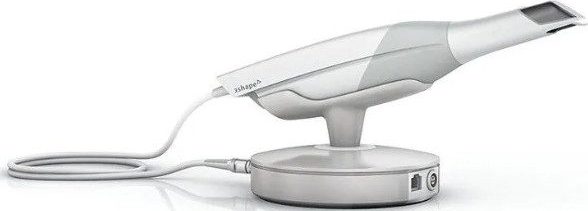
3Shape TRIOS 3 Basic Pod
Specifications
- Manufacturing company: 3Shape, Denmark.
- Scan technology: TRIOS 3.
- Scanning accuracy: 4.5 +, 0.9 μm.
- Dimensions: 42 x 274 x 120 mm.
- Connection interface: USB 3.0
- File format: DCM, STL.
- Weight (without packaging): 373 g without stand.
The TRIOS 3 Basic Pod is a compact yet highly technical intraoral 3D scanner.
Advantages
- High scanning speed and accuracy
- Ergonomic design and lightweight
- Professional software with an intuitive interface and many options
- Compatible with any computer or laptop (via USB port).
- Transfer of a color picture.
In addition to everything necessary for the operation of the device, the scope of delivery includes 5 removable tips that can be autoclaved, a special stand and a set for color calibration.
3. Planmeca Emerald Intraoral 3D scanner


Planmeca Emerald
Specifications
- Manufacturing company: Planmeca Oy, Finland.
- Scanning technology: projected triangulation, where 3 laser beams are involved – red, blue, green.
- Scanning accuracy: 10 microns.
- Dimensions: 41 x 45 x 249 mm.
- Connection interface: USB 3.0.
- File format: STL, PLY.
- Weight (without packaging): 235 g.
Small, lightweight and ultra-fast, the Planmeca Emerald intraoral scanner features the latest in scanning and processing technology.
Advantages
- High speed and precision. You can get a detailed 3D image of the entire jaw in just a couple of minutes.
- Modern appearance and lightness. Thanks to its ergonomic design and high aesthetic properties, the 3D scanner is convenient and pleasant to use.
- Anti-fogging. This function eliminates any interference with the device.
- Accurate color reproduction. High-resolution cameras enable full-shade volumetric imaging and use this to realistically simulate future restorations and crowns.
- It ha s2 types of autoclavable tips. One is standard while the other is thinner, The thinner is for working with small patients, as well as for better display of hard-to-reach places (posterior teeth, interdental spaces, etc.).
- The ability to import and export the resulting files. 3D models are translated into STL and PLY formats, which makes it easy to exchange them if necessary without any complications or use of third-party services.
- Can be operated with a pedal.
4. 3Shape TRIOS 3 Pod Intraoral 3D Scanner


3Shape TRIOS 3 Pod
Specifications
- Manufacturing company: 3Shape.
- Scan technology: TRIOS 3.
- Scanning accuracy: 4.5 ± 0.9 μm.
- Dimensions: 42 x 274 x 120 mm.
- Connection interface: USB 3.0
- File format: DCM, STL.
- Weight (without packaging): 373 g (without stand).
This is a high-quality intraoral 3D scanner capable of obtaining accurate digital impressions of all teeth, without distortion and loss of image clarity.
Advantages
- Efficiency. No matter where the patient is (straight or tilted), the scanner will accurately transmit all the details of the dentition, even the chewing teeth.
- The patented ultra-fast scanning technology ensures accurate images in the shortest possible time. You can get a digital impression of the entire jaw in just a few minutes.
- Ease of use. The intuitive interface and ergonomic design of the scanner make it very easy to use.
- Open file exchange system. The panoramic 3D model can be easily exported for further use by other specialists – orthodontists, therapists, orthopedists, and even a third-party laboratory.
- Powder-free scanning. This device does not require matting powder to get a high-quality image. Therefore, the whole process more comfortable and simple.
The 3Shape TRIOS 3 Pod differs from the 3Shape TRIOS 3 Basic Pod, which we discussed above, in terms of features and the maximum detail derived from a scanned object.
Advantages
- High resolution quality. The scanner has an option for recognizing and reproducing tooth color. This makes it easier for the doctor to select the right shade for restorations, crowns or veneers.
- Patient Specific Motion allows you to record the movement of the patient’s jaw.
- Orthodontic Treatment Visualizer helps you to see how your teeth will look after wearing braces or aligners.
- Smile design. The scanner allows you to obtain complete data of the oral cavity and project the final result to create a beautiful smile. The data can be superimposed on the patient’s photo for visual demonstration.
- The ability to track changes in the dentition at each visit thanks to the “Patient Monitoring” function.
- The ability to digitize various types of casts, including those made of plaster or polymers.
Dental Lab 3D Scanners
In addition to intraoral 3D scanners, there are also laboratory scanners. These dental 3D scanners take pictures not from a patient, but in a dental laboratory, by scanning a plaster impression made in a standard way.
With the help of directional structured light, the scanner collects a point cloud (the coordinates of an object in space) and builds a 3D model based on it. The device does this automatically without human intervention. Special software analyzes the information received and creates a digital image on the monitor screen.


The use of laboratory 3D scanners in dentistry
This scanning method is highly accurate. In this case, the conditions are quite favorable: good lighting, full access to all parts of the object, and its immobility. As a result, the quality of the images is excellent. Every detail is conveyed without distortion.
However, plaster casts do not provide information about the real color of the teeth. Therefore, the doctor will select the desired color and shade of the prosthesis or restoration. However, most laboratory 3D scanners have functions that allow you to color correct the image. There are also options for “refining” a 3D model based on the task at hand.
Best Laboratory 3D Scanners
Laboratory 3D scanners, like intraoral ones, significantly improve the quality of dental services. Today, no good clinic can do without such equipment. If you are thinking about buying such a device or replacing an outdated 3D scanner, here are the best options to consider.
1. Laboratory 3D scanner Shining 3D AutoScan-DS300


Shining 3D AutoScan-DS300
Specifications
- Manufacturing company: Shining 3D, China.
- Scanning technology: structured blue light.
- Scanning accuracy: <10 mcr.
- Camera: 3.0MP
- Connection interface: USB 3.0
- File format STL, OBJ.
- Weight 26 kg.
- Dimensions: 500 x 356 x 320 mm.
This is a universal laboratory 3D scanner with high scanning accuracy. The scanner can digitize even glare surfaces (including metal and wax products) and dental impressions of all types, using blue light.
Advantages
- Fast scanning and data analysis.
- Availability of 2 high-resolution cameras (3 Mp).
- Possibility of scanning the model in the articulator.
- Software with a user-friendly interface and the ability to convert data into a virtual articulator.
- Compact size and stylish design.
- Full transfer of the texture of the object and all shades of color.
- Scanning without the use of powder.
- It works in a preset mode. The device is configured and calibrated automatically.
- Large scan area.
- High level of detail.
2. Laboratory 3D scanner AutoScan DS-EX PRO

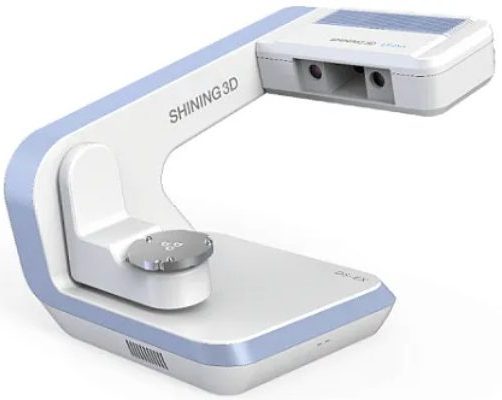
AutoScan DS-EX PRO
Specifications
- Manufacturing company: Shining 3D, China.
- Scanning technology: structured light.
- Scanning accuracy: up to 10 micrometers.
- Camera: 1.3 Mp.
- Connection interface: USB 3.0
- File format STL, OBJ.
- Weight 5 kg.
- Dimensions (without packaging): 260x270x420 mm.
This is a quite budgetary, easy to use, compact and reliable 3D scanner.
Advantages
- Compatible with almost any open CAD/CAM system, as well as with articulators of various brands.
- There is an option for both color and black and white scanning.
- Works without powder.
- Transfers the texture of the scanned object.
- Digitizes any impressions, stamps, models (both plaster and wax), including in an articulator, etc.
- Can work even in low light and reflective surfaces.
- Compact and lightweight (only 5 kg).
- Autoscan DS-EX PRO software is presented in multiple languages and has a user interface selection function: for laboratories and clinics (simplified version). In addition, it is fully integrated into Exocad. Therefore, there is no loss in image quality when converting.
- The kit includes a variety of holders for dies, impressions, adapters, stands for different types of scanning, plasticine for fastening, a cloth for optics, cables, a calibration panel, etc.
- The upper part of the scanner is removable, Therefore, it can be replaced with an updated version if necessary.
- The fast bite scan function allows the impression to be digitized without rotation.
Should You Buy a Dental 3D Scanner?
Modern technologies greatly facilitate and simplify various processes in dentistry. Crowns, bridges, prostheses and other dental structures created with a 3D scanner are more accurately than those made by taking impressions.
Sooner or later, the old ways of taking dental impressions while phase out. If you want to keep up with the times and retain customers’ trust, embrace technological developments. This will help you to be competitive and improve the quality of your services.
Laboratory and intraoral scanners make dentistry work more comfortable and efficient. 3D modeling allows you to carry out various manipulations with the resulting model to get the perfect model that does not have to be redone later. This saves you and your patients both time and money.
If you are unsure which dental 3D scanner is right for your clinic, get in touch with our specialists to learn the pros and cons of each of the devices on our review.